
Imagine a storm that rolls through the area. What does your house smell like after the rain has dispersed? If you inhale and smell a damp, earthy, or musty scent inside your home after it rains, it means that moisture is somehow getting inside. With South Jersey frequently experiencing humidity, rain, and seasonal temperature changes throughout the year, homeowners should look for the source of the humidity before it begins to negatively affect the exterior and interior of the home.
Key Takeaways
- A musty smell after rain can indicate excess moisture around your roof, windows, doors, siding, attic, or other areas of your home.
- Clogged gutters and poor drainage can allow water to collect around the roofline or foundation, increasing the risk of moisture problems.
- Poor attic or interior ventilation can allow moisture-laden air to linger, making musty odors more noticeable after rainy weather.
- Pay attention to where and when the smell appears. A recurring musty odor after rain can help point to the source of a moisture problem.
- If the smell keeps returning, or you notice water stains, damp insulation, damaged roofing, or other signs of moisture, it’s time to have the problem evaluated.
Here is everything you need to know about your house smelling musty after it rains.
What Causes a Musty Smell After It Rains?
There can be several areas that cause the musty smell in your home, including the attic and roof spaces, walls and insulation, siding and exterior walls, windows and doors, and more. However, most homeowners know how hard it can be to follow a smell to its source.
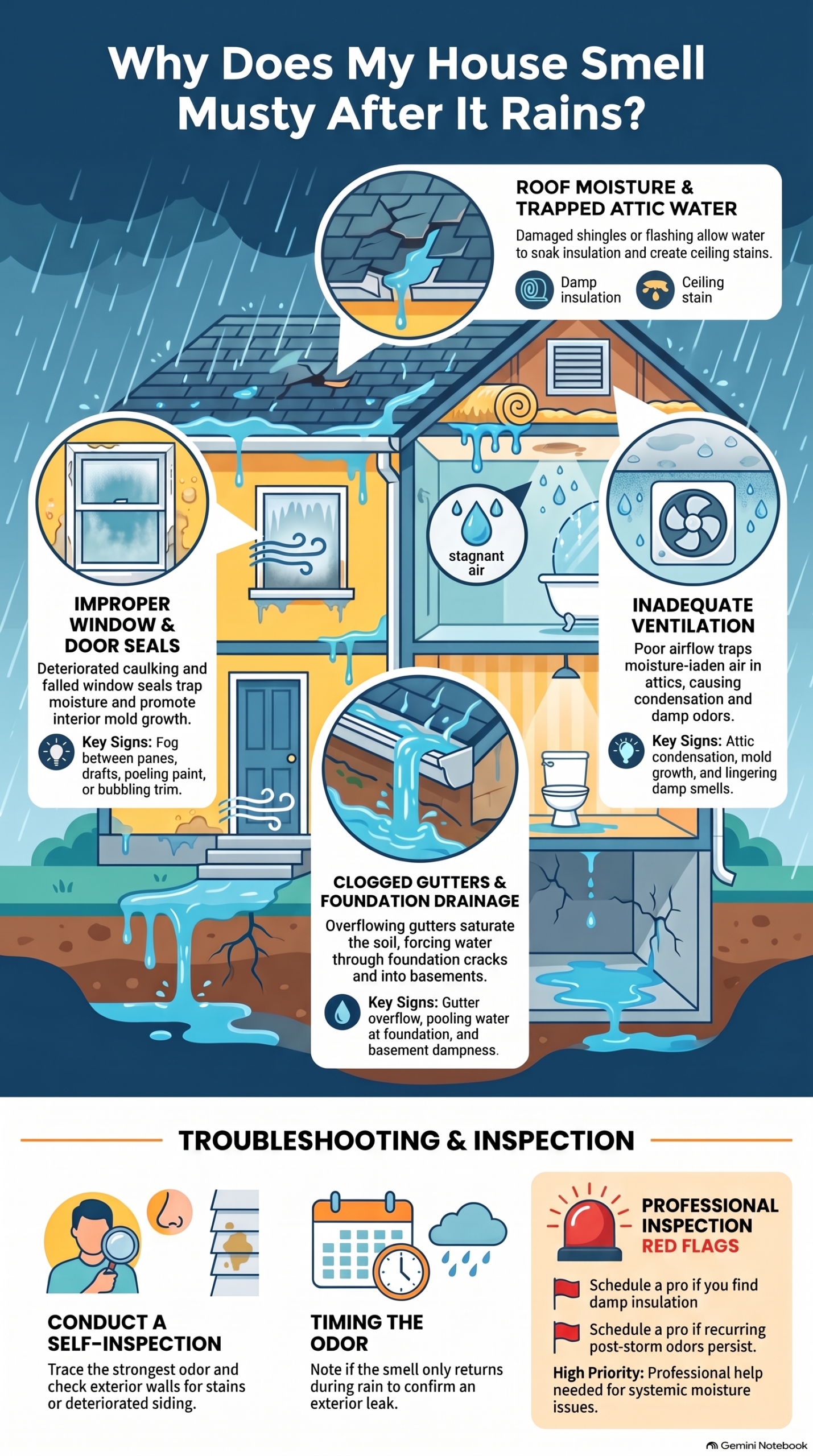
If you notice a musty odor in your home after it rains, check these four potential problem areas first:
1. Improper Seal Around Windows
When a window or door isn’t properly sealed, it allows moisture to infiltrate into tiny spaces, where it can accelerate mold and mildew growth. Take, for instance, a double- or triple-pane window. If the seal inside begins to deteriorate from age or UV exposure, the gases that insulate may escape, leading to moisture flowing into the space. You will notice moisture inside the window that cannot be wiped away. The same is true for seals and caulking.
You may notice that your windows and doors aren’t properly sealing when you feel a draft or a noticeably cooler or warmer temperature in front of the area. Furthermore, your home may smell musty after rain.
2. Roof Moisture
Another cause of musty odors within the home is moisture that is trapped under the roof. Consider the age of your roof. If you have asphalt shingles, the consistent humidity may cause them to age quickly. Summer storms, strong winds, and other environmental factors can also weaken your roof in places, allowing water to seep underneath and past the underlayment.
If you suspect that your roof is the cause of the musty smell after a storm, look for the following clues:
- Water stains on the ceiling or walls
- Mold growth in the attic or crawlspaces
- Overflowing gutters
- Damaged fascia and soffits
- Visibly curling or cracked shingles
3. Clogged Drainage
A drain that doesn’t flow can’t redirect water properly. That may lead to standing water or water that flows backward toward more vulnerable sections of the roof—like the fascia and soffits. When that happens, water has direct access to the underside of the roof. It can then flow along the path of least resistance, entering the structure.
Clogged gutters also increase the chance of overflow, which can deposit water along the foundation. If the ground around the foundation remains saturated, it can cause damage. In turn, water might get in through the roof and the basement. That will truly lead to a damp smell.
Be sure to clean your gutters at least twice a year. If your South Jersey home is surrounded by mature trees, you may need cleaning more often.
4. Ventilation Issues
If your house has a ventilation problem, you will know by the smell. Moisture-laden air may get trapped in the attic when ventilation is poor.
What does this mean? In South Jersey homes with attics and crawlspaces, inadequate airflow may cause moisture to linger around the roof deck, frame, and insulation, causing damage from the inside out.
Bathrooms, kitchens, and other regions of the house that may produce humidity may contribute to excess moisture inside if they aren’t properly ventilated. If you notice a musty smell, condensation, damp insulation, staining, or visible moisture in the attic, your home may lack ventilation.
Why Does the Smell Get Worse After It Rains?
Noticing the pattern of how humidity leads to a musty odor can help you begin to pinpoint the issue.
When it rains, the falling precipitation may increase the outdoor humidity. Additional moisture in the air may make damp materials smellier. Homes with inadequate ventilation tend to hold onto moisture longer.
This is but one way rain may expose existing moisture problems. Water can enter tiny cracks between shingles, flashing, siding, doors, and windows and stay there. The more humid the surrounding air, the longer it takes for the components to dry. Furthermore, wood, drywall, insulation, and similarly porous materials tend to retain moisture.
How to Find Where the Musty Smell Is Coming From
The timing of the odor is the biggest clue. If the smell starts after it rains, try to find where the odor is the strongest. Additionally, if you suspect that some materials are already damp—from storm damage, for example—go there first.
As you look through the house, ask yourself the following questions:
- Which room is producing the strongest odor?
- Is the smell stronger near an exterior wall?
- Is the musty smell coming from the ceiling or upper floor?
- Is the scent coming from the basement, crawlspace, or lower level?
- Are there visible signs of water damage nearby?
Next, take a look outside. If you notice pooling water around the foundation, visible deterioration around windows or siding, lifted shingles or flashing, and gutter damage, it may be a roof leak causing the musty smell.
When Should NJ Homeowners Call a Professional?
A musty smell that occurs once and never again often means that the humidity levels in your home diminished over time. Rarely will you have something to worry about in that case. However, if the musty odor returns after every rain, don’t ignore it.
It is recommended that you call a professional if:
- The smell returns after a significant rain.
- You locate stains and moisture within your home.
- There is evidence of water damage around your windows or doors.
- The insulation in your attic is damp or smells musty.
- Gutters overflow during storms.
- The problem—or the smell—is spreading.
A roofing inspector in South Jersey can evaluate the exterior components of your home, including the gutters, siding, and windows and doors, to locate where the moisture intrusion begins. They will advise you about what to do next if you do have a roofing problem.
Frequently Asked Questions
Can a roof leak cause a musty smell?
Yes. Water that gets beneath shingles or around flashing can remain trapped in roofing materials, insulation, or other parts of the home. If the moisture doesn’t dry out, it can contribute to a musty odor.
Why does my house only smell musty when it rains?
Rain can increase humidity and add moisture to materials that are already damp. If your home has a moisture intrusion, drainage, or ventilation problem, the odor may become much more noticeable during and after rainy weather.
Can siding cause a musty smell inside my house?
Moisture can sometimes get behind damaged or improperly sealed siding and become trapped against the materials underneath. If you notice a musty smell near an exterior wall, look for signs of moisture or deterioration around the siding, windows, doors, and trim.
Why does my attic smell musty after rain?
A musty attic can be a sign of trapped moisture. Possible causes include a roof leak, damp insulation, condensation, or inadequate ventilation. Look for staining, visible moisture, condensation, or damp insulation when checking the area.
Should I be concerned if my house smells musty after every storm?
A recurring musty smell after rain shouldn’t be ignored. It may indicate that moisture is repeatedly entering or accumulating somewhere in the home. If the odor returns after significant rain or you notice visible moisture or water damage, consider having the source evaluated by a professional.
Conclusion: Don’t Ignore Musty Smells
If your house smells musty after it rains, don’t light a candle and hope for the best. You may need to call a roofing inspector to see if the smell is the result of a roofing issue. Identifying the source of the issue early can prevent much larger, more extensive repairs down the road.
T.A. Hughes III has served South Jersey for over 45 years. If your home feels damp and smells musty after it rains, give our team a call.