
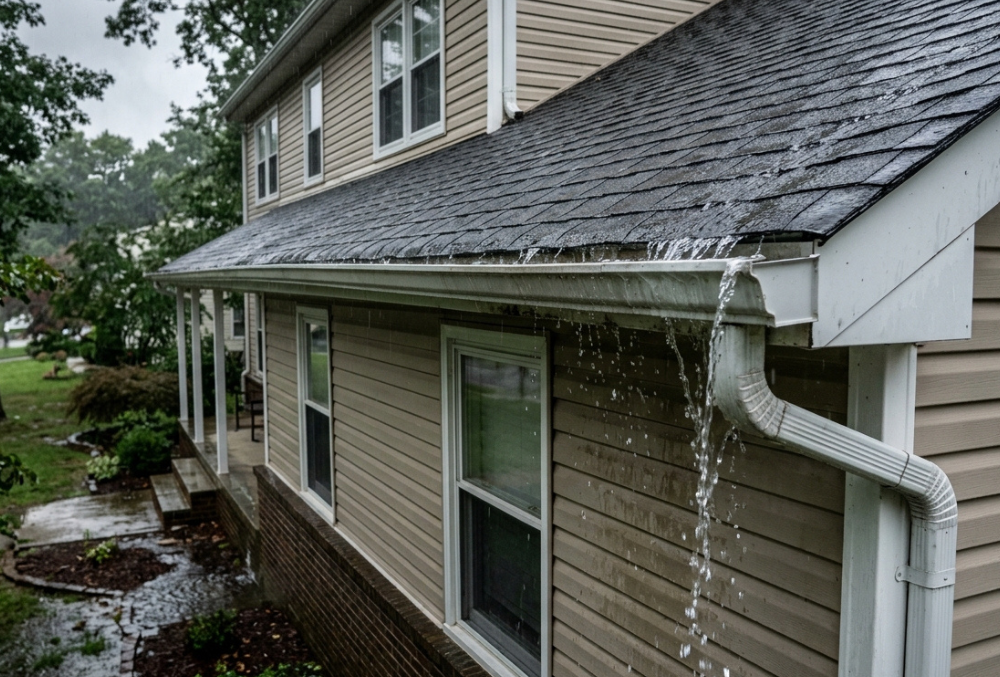
When gutters overflow during heavy rain, most homeowners see it as a gutter problem. Water pours over the edge, splashes onto the ground, stains the siding, or pools near the foundation. But overflowing gutters can also become a roofing problem.
Your gutters are part of your home’s water-control system. Their job is to collect rainwater from the roof and move it safely away from the house. When they clog, sag, leak, or cannot handle the amount of water coming off the roof, rainwater can back up near the roofline and create damage to shingles, fascia, soffits, siding, and even interior ceilings.
For South Jersey homes, this is especially important during heavy summer storms, fall leaf season, winter freeze-thaw cycles, and fast-moving rain systems across Gloucester, Camden, and Burlington Counties. If your gutters overflow every time it rains hard, it is worth finding out why before the water causes bigger problems.
Why Do Gutters Overflow During Heavy Rain?
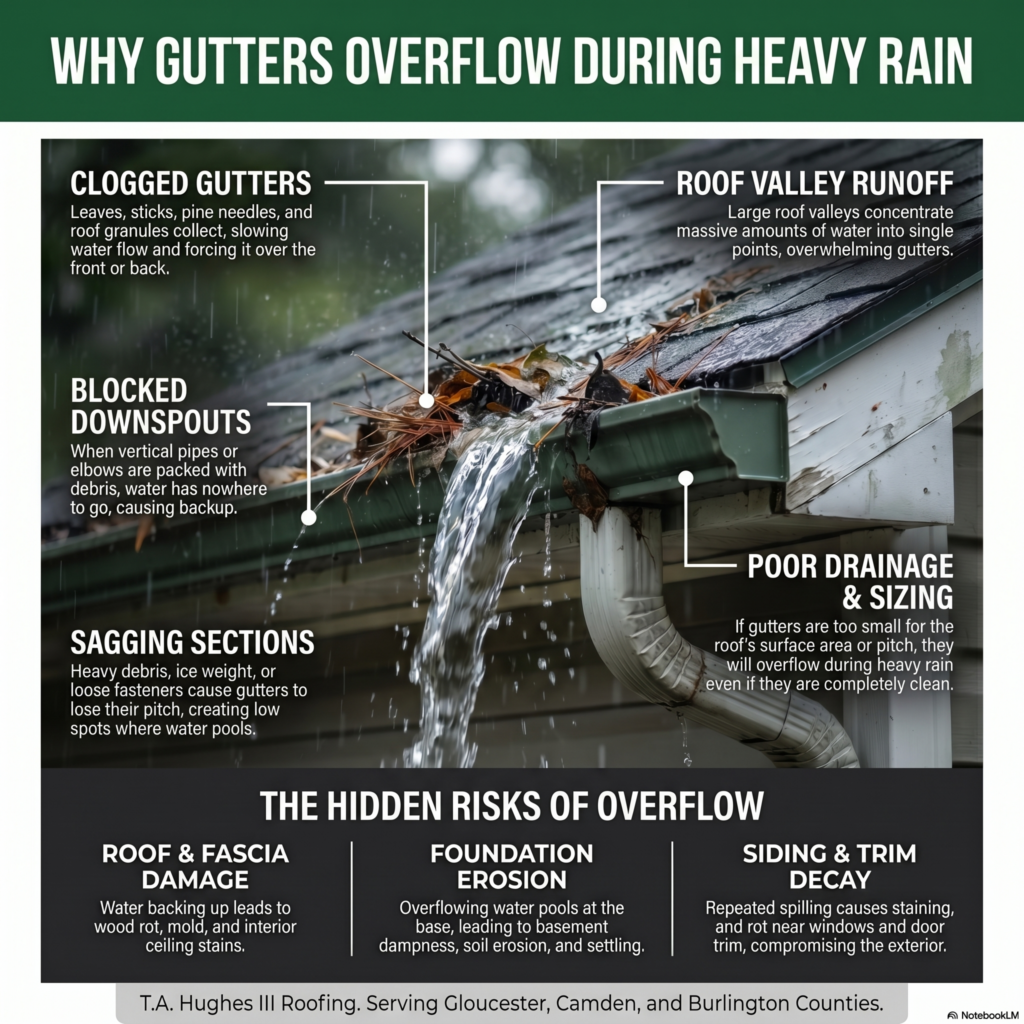
Gutters usually overflow during heavy rain because they are clogged, sagging, undersized, poorly sloped, or blocked at the downspouts. In South Jersey, leaves, roof granules, pine needles, and storm debris can prevent water from draining properly. Overflowing gutters can damage the roof edge, fascia, soffits, siding, foundation, landscaping, and even contribute to roof leaks near exterior walls.
Quick Answer: Why Do Gutters Overflow During Heavy Rain?
Gutters usually overflow during heavy rain because they are clogged, sagging, undersized, poorly sloped, disconnected from the downspout, or overwhelmed by water coming from a large roof area. In South Jersey homes, leaves, roof granules, pine needles, storm debris, and clogged downspouts are common causes.
Overflowing gutters can damage the roof edge, fascia, soffits, siding, foundation, landscaping, and basement areas. If water is backing up near the roofline or staining the home, schedule gutter repair and cleaning in South Jersey before the problem gets worse.
Why Gutters Matter More Than Most Homeowners Realize
Gutters do not just keep rain from dripping near your front door. They protect several important parts of your home at the same time.
A working gutter system helps protect:
- The roof edge
- Fascia boards
- Soffits
- Siding
- Windows and doors
- Landscaping
- Foundation walls
- Basement areas
- Walkways and entry points
When gutters fail, water does not simply disappear. It looks for the easiest path downward. That may mean running behind the gutter, soaking the fascia, spilling over the siding, backing up under shingles, or pooling next to the foundation.
That is why gutter overflow should not be ignored, especially if it happens repeatedly during heavy rain.
Common Reasons Gutters Overflow During Heavy Rain
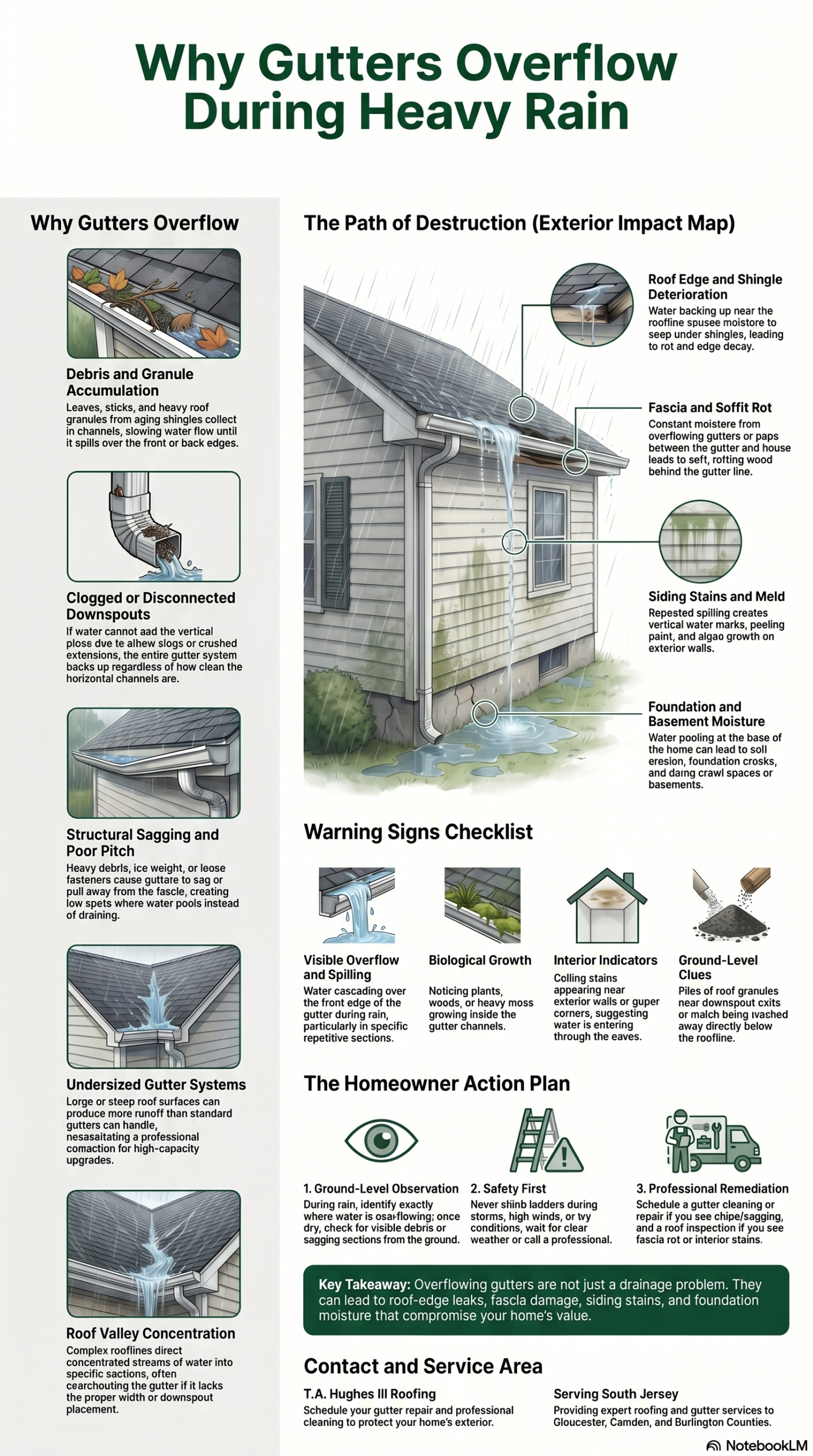
Overflowing gutters can have more than one cause. Sometimes the problem is as simple as a clog. Other times, the gutter system may be damaged, poorly pitched, undersized, or overwhelmed by the shape of the roof.
Here are the most common causes T.A. Hughes III Roofing sees on South Jersey homes.
1. Leaves, Debris, and Roof Granules Are Blocking Water Flow
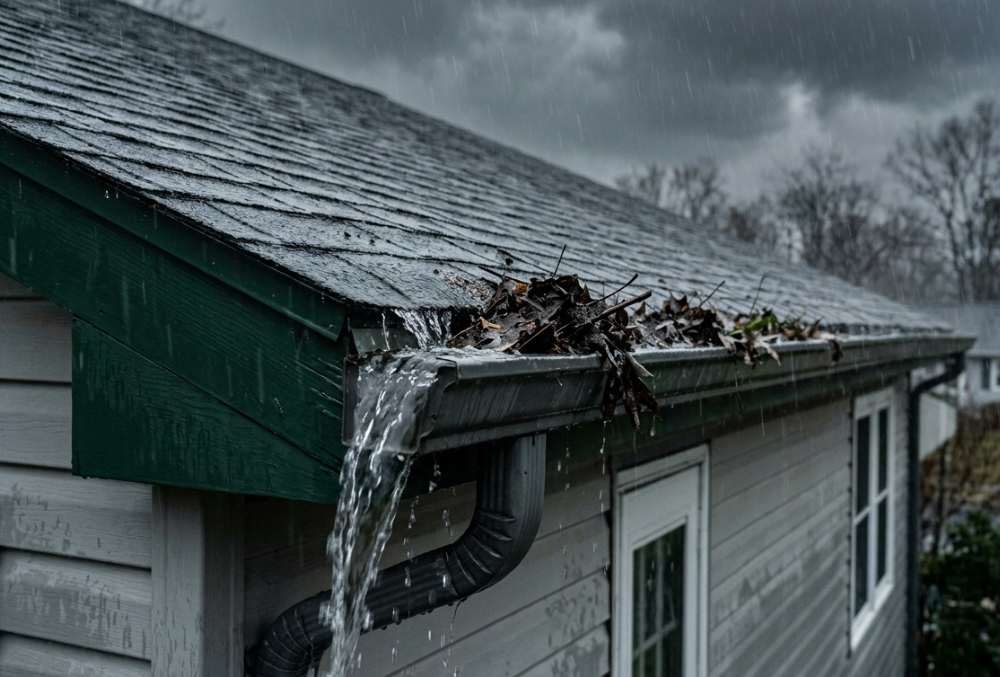
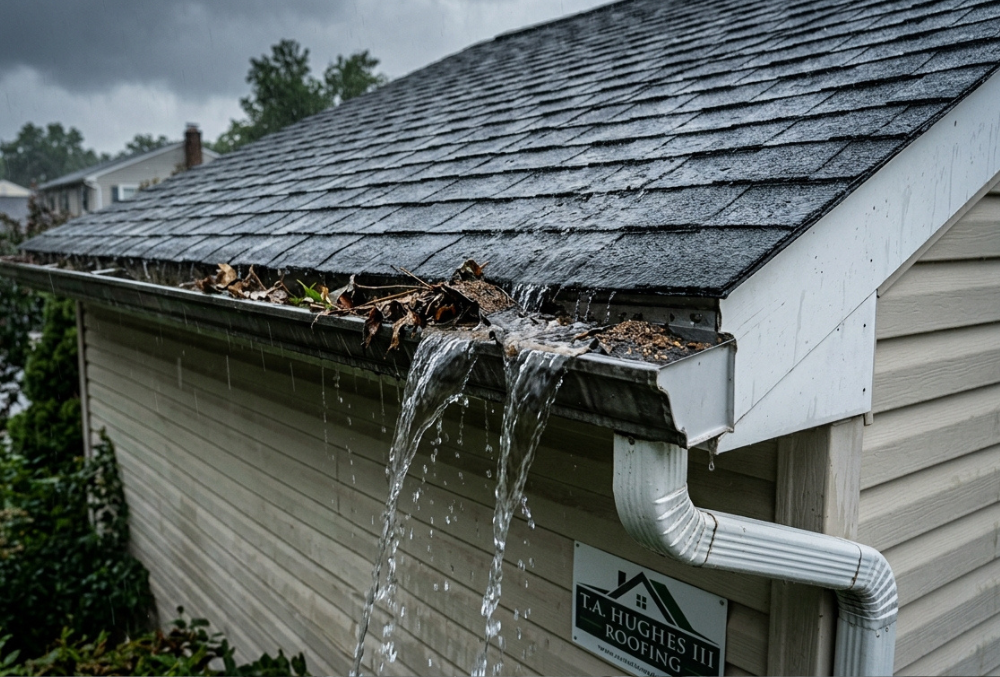
The most common reason gutters overflow is a blockage. Leaves, sticks, pine needles, seed pods, roof granules, and storm debris can collect inside the gutter and slow down water flow.
During light rain, the gutter may still seem to work. During heavy rain, water cannot move fast enough through the blocked section, so it spills over the front or back of the gutter.
Warning signs of clogged gutters include:
- Water spilling over the same section during rain
- Plants or weeds growing in the gutter
- Stains on siding below the gutter
- Dirt lines on the outside of the gutter
- Water pooling near the foundation
- Dripping from behind the gutter
- Granules collecting near downspouts
If your home has trees nearby, gutter clogs can happen quickly after storms or during fall leaf season.
2. Downspouts Are Clogged or Not Draining Properly
Even if the gutter channel is clear, water still has to leave through the downspout. If the downspout is blocked, crushed, disconnected, or draining too close to the home, the entire system can back up.
A clogged downspout can make the gutter look like it is too small when the real problem is that water has nowhere to go.
Common downspout problems include:
- Leaves packed into the top elbow
- Debris stuck inside the vertical pipe
- Downspout extensions missing
- Water discharging next to the foundation
- Underground drains blocked
- Downspouts pulling away from the house
If water is rushing over the gutter near the downspout, the downspout should be checked first.
3. Gutters Are Sagging or Pulling Away From the Fascia
Gutters need the right angle to move water toward the downspouts. If they sag, pull away, or loosen from the fascia, water can collect in low spots instead of draining properly.
Sagging gutters are often caused by:
- Heavy debris buildup
- Loose hangers or fasteners
- Water weight
- Ice weight in winter
- Aging fascia boards
- Improper installation
- Storm damage
When gutters pull away from the fascia, water may run behind the gutter instead of into it. Over time, this can damage fascia boards, soffits, and the roof edge.
If you see a gap between the gutter and the roofline, the system should be repaired.
4. The Gutters May Be Too Small for the Roof Area
Some homes need more drainage capacity than others. A large roof surface, steep roof pitch, long gutter run, or multiple roof valleys can send a lot of water into one section of gutter during heavy rain.
If the gutters are too small or there are not enough downspouts, the system may overflow even when it is clean.
This is common on homes with:
- Large roof sections
- Steep roofs
- Long uninterrupted gutter runs
- Complex rooflines
- Valleys that dump water into one area
- Additions that changed drainage patterns
If you are not sure whether your gutter system is sized correctly, use the T.A. Hughes gutter sizing calculator as a starting point. A professional evaluation can also help determine whether additional downspouts or gutter adjustments are needed.
5. Roof Valleys Are Sending Too Much Water Into One Spot
Roof valleys collect water from two roof slopes and direct it downward. During heavy rain, a valley can send a concentrated stream of water into a small section of gutter.
If that section is clogged, undersized, or missing a properly placed downspout, water may shoot over the gutter completely.
Signs of roof-valley-related gutter overflow include:
- Overflow happening in one specific area
- Water spilling over during heavy rain only
- A valley ending above the problem section
- Stains on siding below the valley
- Mulch or soil washing away below the gutter
Because roof valleys already handle more water than other roof areas, drainage problems there should be taken seriously.
How Overflowing Gutters Can Damage Your Roof
Overflowing gutters can damage more than the gutter system itself. When water backs up near the roof edge, it can affect the materials that protect the lower edge of the roofing system.
Possible roof-related problems include:
- Water soaking fascia boards
- Soffit damage
- Roof-edge moisture
- Shingle edge deterioration
- Ice-related problems in winter
- Water entry near the eaves
- Hidden rot behind gutters
- Interior stains near exterior walls
If your ceiling stains appear near an outside wall or upper corner, gutter overflow may be part of the problem. A professional roof inspection can help determine whether water is entering from the roof, gutter line, flashing, siding, or attic area.
How Overflowing Gutters Can Damage Siding and Trim
When gutters spill water over the side of the house, siding and trim can take the impact. Over time, repeated overflow can create staining, moisture problems, and damage behind the visible surface.
Look for:
- Stains running down siding
- Peeling paint near trim
- Soft fascia or soffit areas
- Warped siding
- Mold or algae growth
- Water marks below gutter seams
- Rot near corners or window trim
Siding protects the structure beneath it. If water repeatedly runs behind or against siding, small exterior issues can eventually become hidden moisture problems.
How Overflowing Gutters Can Affect the Foundation
Gutters are supposed to move water away from the foundation. When they overflow or discharge too close to the home, water can pool around the base of the house.
This can lead to:
- Soil erosion
- Foundation moisture
- Basement dampness
- Water near crawl spaces
- Settling around walkways
- Landscaping washout
- Mold or mildew concerns in lower areas
This is why downspout direction matters. Even a clean gutter can cause problems if the downspout empties too close to the foundation.
Are Gutter Guards the Answer?
Gutter guards can help reduce clogs, especially for homes with heavy tree coverage. They can keep leaves, sticks, and larger debris out of the gutter channel, helping water move more consistently.
However, gutter guards do not eliminate maintenance completely. Roof granules, small debris, pine needles, and debris buildup on top of the guard can still affect water flow.
T.A. Hughes offers Leaf Relief gutter protection for South Jersey homeowners who want to reduce gutter clogs and improve drainage performance.
Gutter guards may be worth considering if:
- Your gutters clog often
- Your home has trees nearby
- You clean gutters several times a year
- Water overflows during storms
- Leaves collect along the roofline
- You want to reduce maintenance
The best option depends on your roofline, trees, gutter condition, and drainage needs.
What to Do If Your Gutters Overflow During Heavy Rain
If your gutters overflow during heavy rain, do not ignore it. The water is telling you the system is not moving runoff properly.
Start by looking for obvious signs from the ground:
- Are leaves visible inside the gutter?
- Is water spilling from one section?
- Is the gutter sagging?
- Is a downspout disconnected?
- Is water pooling near the foundation?
- Are there stains on the siding?
- Does overflow happen only below a roof valley?
Do not climb a ladder during rain, wind, icy conditions, or storms. Wet ladders, slick roofs, and unstable ground can be dangerous.
Once conditions are safe, schedule a gutter or roof evaluation. T.A. Hughes can inspect the gutter system, roof edge, downspouts, fascia, and drainage areas to determine what is causing the overflow.
When Gutter Overflow May Point to a Roof Problem
Sometimes gutter overflow is not only a gutter issue. It may reveal a larger roofing or exterior problem.
Schedule a professional inspection if you notice:
- Ceiling stains near exterior walls
- Water entering the attic
- Rotten fascia or soffits
- Missing shingles near the roof edge
- Granules collecting in gutters
- Overflow after every storm
- Water stains below roof valleys
- Dripping behind the gutter
- Previous roof leaks in the same area
If water is already entering your home, the problem should be addressed quickly. Gutters, roof edges, and flashing should all be checked together.
Need Help With Overflowing Gutters in South Jersey?
Overflowing gutters are more than an annoyance. They can damage your roofline, siding, fascia, soffits, foundation, and interior areas if the water keeps backing up or spilling where it should not.
T.A. Hughes III Roofing helps homeowners throughout Gloucester, Camden, and Burlington Counties with gutter repair, gutter cleaning, Leaf Relief gutter protection, roof inspections, roof repair, siding, windows, and exterior services.
If your gutters overflow during heavy rain, schedule gutter repair and cleaning in South Jersey.
If you are seeing ceiling stains, water near the roofline, or signs of hidden moisture, schedule a professional roof inspection.
FAQs
Why do my gutters overflow during heavy rain?
Gutters often overflow during heavy rain because they are clogged with leaves, roof granules, sticks, or debris. Overflow can also happen when downspouts are blocked, gutters are sagging, the slope is wrong, or the gutter system is too small for the roof area.
Can overflowing gutters cause roof leaks?
Yes. Overflowing gutters can contribute to roofline leaks by allowing water to back up near the roof edge, fascia, soffits, or siding. This can lead to hidden moisture damage and may create interior stains near exterior walls.
How do I know if my gutters are clogged or too small?
If your gutters overflow in one spot, they may be clogged or sagging. If they overflow across long sections during heavy rain even when clean, they may be undersized or may need more downspouts. A gutter inspection can help determine the cause.
Are gutter guards worth it for South Jersey homes?
Gutter guards can be helpful for South Jersey homes with trees, frequent clogs, leaf buildup, or heavy roof debris. They can reduce maintenance, but they do not eliminate it completely. The right solution depends on the home’s roofline, tree coverage, and drainage needs.
How often should gutters be cleaned?
Most South Jersey homes should have gutters checked at least twice a year, usually in spring and fall. Homes with heavy tree coverage, frequent storms, or recurring overflow may need more frequent cleaning.
When should I call a professional for overflowing gutters?
Call a professional if your gutters overflow during every heavy rain, pull away from the house, leak at seams, drain too close to the foundation, or cause stains on siding, fascia, soffits, or ceilings.