
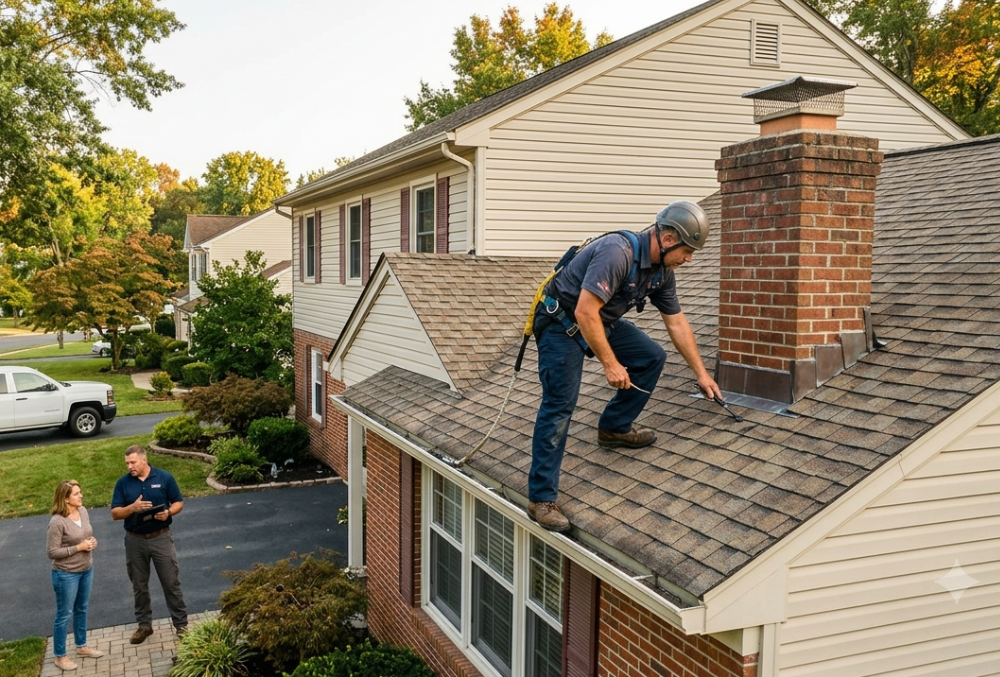
A note before you read: The price ranges in this article are drawn from 2026 regional contractor data across South Jersey — not from T.A. Hughes pricing. We have included them because homeowners need a realistic planning baseline before calling anyone. What T.A. Hughes charges for your specific roof depends on factors that cannot be measured from a satellite image or a calculator: the actual surface area, pitch, number of existing layers, decking condition, ventilation, and flashing scope. The only honest price for your roof is the one that comes after a licensed professional walks it. Request a free inspection to get a number that actually applies to your home.
Most South Jersey homeowners searching for a roof price online run into the same frustration: every source quotes a different number, and none of them explains why two houses on the same street can get estimates that differ by $6,000 or more. The short answer is that a new roof is not a fixed-price product. It is a custom assembly of labor, materials, and site conditions that no calculator can measure from a satellite image.
At T.A. Hughes III Roofing, we have been inspecting and replacing roofs across Burlington, Camden, and Gloucester counties for more than 35 years. This guide breaks down exactly what drives the price of a new roof in South Jersey in 2026, what you should expect to see in a quality estimate, and why the only way to get your real number is a professional on-site inspection.
Before You Call Anyone: A 10-Point Roof Self-Assessment
Most homeowners call a roofer without knowing whether their roof needs a repair, a replacement, or simply a cleaning. This quick self-assessment takes about 15 minutes and gives you useful context before you request any estimate. You do not need to get on the roof — everything here can be assessed from the ground or from inside your attic.
Score each item and total at the bottom. Be honest. No one is grading you.
| What to Check | What You Are Looking For | Score This Item |
|---|---|---|
| 1. Age | Do you know when the roof was last replaced? Architectural shingles last 25 to 30 years in South Jersey. | Under 15 years: 0 pts | 15 to 20 years: 1 pt | Over 20 years or unknown: 2 pts |
| 2. Shingle curling | From the ground, look at the edges and valleys. Are shingles curling up at the edges (cupping) or in the middle (clawing)? | None visible: 0 pts | A few isolated shingles: 1 pt | Multiple slopes or widespread: 2 pts |
| 3. Granule loss | Check your gutters after rain. Asphalt shingles shed granules (they look like coarse sand) as they age. Heavy accumulation means the shingles are near the end of their useful life. | Trace amounts: 0 pts | Noticeable layer: 1 pt | Heavy deposits or bare patches visible on shingles: 2 pts |
| 4. Missing or damaged shingles | Scan the roof from the ground. Are any shingles visibly missing, cracked, or broken? | None: 0 pts | One to three isolated areas: 1 pt | Multiple areas or after every storm: 2 pts |
| 5. Active leaks or ceiling stains | Any brown stains on ceilings, peeling paint near exterior walls, or water marks near chimneys or skylights? Our article on what a brown ceiling stain means explains what each pattern indicates. | No stains: 0 pts | Old stain, no active leak: 1 pt | Active or recurring leak: 2 pts |
| 6. Attic condition | If you can access your attic safely, look at the underside of the decking. Dark staining, soft spots, or visible daylight through the boards are serious warning signs. | Clean, dry decking: 0 pts | Minor staining or isolated soft spot: 1 pt | Visible rot, mold, or daylight: 2 pts |
| 7. Flashing around chimneys and vents | From the ground or a window with line of sight, look at where the roof meets the chimney or any vertical walls. Is the metal flashing intact, or does it look lifted, rusted, or separated? | Appears intact: 0 pts | Questionable in one spot: 1 pt | Clearly separated or rusted: 2 pts |
| 8. Sagging | Does the roofline look straight from the street, or do you see any dips or sagging between rafters? Sagging is a structural issue, not just a cosmetic one. Our guide covers why roofs sag and when it is an emergency. | Straight and flat: 0 pts | Minor dip in one area: 1 pt | Visible sagging across spans: 2 pts |
| 9. Moss, algae, or heavy staining | Algae causes the dark streaks you see on many South Jersey roofs. Moss and lichen are more serious — they hold moisture and lift shingles over time. More on this in our algae and moss guide. | Clean or minor discoloration: 0 pts | Algae streaking on one slope: 1 pt | Moss, lichen, or heavy growth: 2 pts |
| 10. Repair history | How many times has the roof been patched or repaired in the last five years? Repeated repairs on an aging roof are a signal that the underlying system is failing. | None or one minor repair: 0 pts | Two or three repairs: 1 pt | Four or more, or ongoing leaks despite repairs: 2 pts |
Your score guide:
| Total Score | What It Suggests |
|---|---|
| 0 to 4 | Your roof may be in reasonable shape. Schedule a professional inspection if it has been more than five years since the last one, or before any major storm season. |
| 5 to 9 | There are signs worth investigating. A professional inspection will clarify whether targeted repairs are sufficient or whether replacement planning should begin. Read our repair vs. replacement guide for additional context. |
| 10 to 20 | Multiple indicators of a roof approaching or past end of life. A professional inspection should happen soon. Waiting increases the risk of interior damage from leaks and can complicate an insurance claim if a storm event occurs. |
This checklist does not replace a professional inspection. It gives you a starting point for the conversation.
The Direct Answer: 2026 South Jersey Roof Cost Ranges
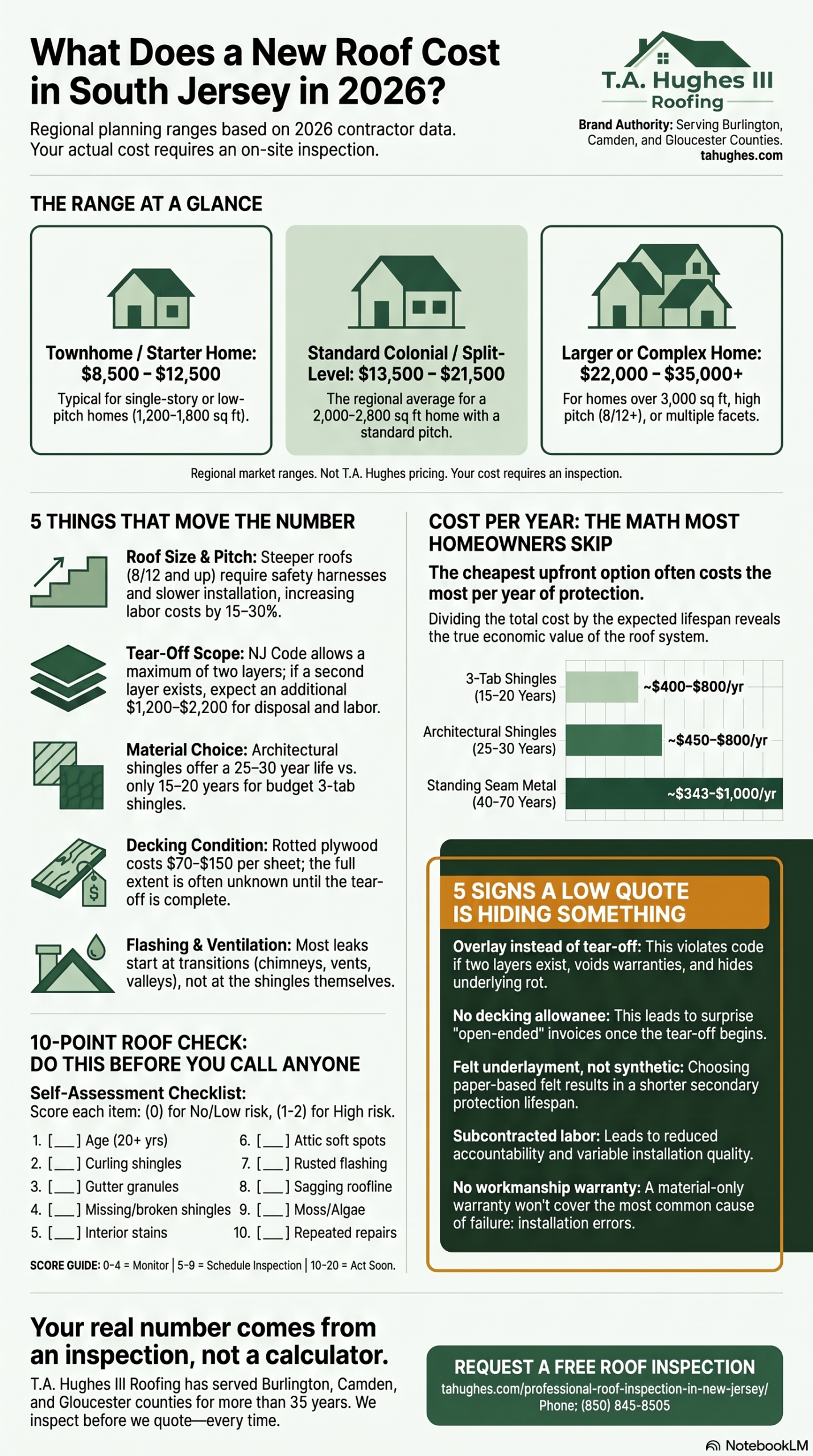
Most South Jersey homeowners pay somewhere between $13,500 and $21,500 for a full asphalt shingle roof replacement in 2026, based on regional project data from Atlantic, Burlington, Camden, and Gloucester counties. This assumes architectural asphalt shingles, a full tear-off, synthetic underlayment, ice-and-water shield, and standard ventilation work.
Important: The ranges below reflect 2026 regional market data compiled from multiple South Jersey contractor sources. They are not T.A. Hughes pricing. Your actual cost depends on a physical inspection of your specific home. Two homes with the same square footage can have very different roofs — different pitches, different numbers of existing layers, different decking conditions, different flashing requirements. No number below applies to your home until a licensed contractor has walked your roof.
| Home Profile | Typical Size | 2026 Regional Range (Arch. Shingles)* |
|---|---|---|
| Townhome or starter home | 1,200 to 1,600 sq ft | $8,500 to $12,500 |
| Standard colonial or split-level | 2,000 to 2,800 sq ft | $13,500 to $21,500 |
| Larger custom or complex home | 3,000+ sq ft, steep pitch, dormers | $22,000 to $35,000+ |
*Regional market ranges based on 2026 contractor data from Atlantic, Burlington, Camden, and Gloucester counties. Ranges assume full tear-off, architectural shingles, synthetic underlayment, ice-and-water shield, and standard ventilation. Decking repairs, second-layer tear-off, flashing replacements, and coastal material upgrades are additional. These figures are not T.A. Hughes quotes. Your price requires a physical inspection.
These ranges do not include decking repairs, which are discovered only after the old shingles come off. That distinction matters more than most homeowners realize.
What a Roof Costs Per Year — The Math Nobody Shows You
Most homeowners look at a roofing estimate and see the total. Almost no one does the math that makes the decision obvious. Here it is.
| Material | Installed Range (2,000 sq ft) | Expected Lifespan in South Jersey | Approximate Annual Cost |
|---|---|---|---|
| 3-tab asphalt shingles | $8,000 to $12,000 | 15 to 20 years | $400 to $800 per year |
| Architectural asphalt shingles | $13,500 to $21,500 | 25 to 30 years | $450 to $860 per year |
| Standing seam metal | $24,000 to $40,000 | 40 to 70 years | $343 to $1,000 per year |
The pattern holds across most projects: when you divide total cost by expected lifespan, a mid-grade architectural shingle roof and a standing-seam metal roof cost roughly the same per year of protection. A 3-tab shingle roof that costs less today often costs more per year once its shorter lifespan is factored in.
The practical takeaway is this: the question worth asking is not “which quote is cheapest?” but “which system protects my home most reliably for the lowest average annual cost?” That answer almost always points away from the cheapest upfront option and toward a properly installed mid-grade or premium system.
How South Jersey Roof Pricing Breaks Down
Five variables explain most of the difference between two quotes on similar homes. Understanding them before you call a contractor will help you compare bids accurately and avoid surprises mid-project. Those variables are: roof size and pitch, tear-off complexity, material choice, what the crew finds under the shingles, and ventilation and flashing condition.
Roof Size, Pitch, and Complexity
Contractors price by the “square,” which equals 100 square feet of actual roof surface. Your roof’s square footage is not the same as your home’s floor plan. Pitch, overhangs, dormers, and multiple roof planes all add surface area. If you want to understand how these structural components affect price, our guide to roof structures breaks it down in detail.
A 2,000 square foot home at a standard 6/12 pitch typically has around 22 to 24 squares of actual roof surface. Steeper roofs at 8/12 or higher require fall protection equipment, slower installation, and more material per square foot, which can add 15 to 30 percent to the labor portion of a quote.
Complexity multiplies the effect further. A simple gable roof on a single-story ranch is the most economical profile. A two-story colonial with multiple valleys, two dormers, a chimney, and a 9/12 pitch will produce a significantly different estimate than its square footage alone would suggest.
Many of the homes T.A. Hughes serves across Burlington and Camden counties were built in the 1980s and 1990s, when housing developments in towns like Marlton, Voorhees, and Washington Township were growing rapidly. Those homes commonly have simple-to-moderate profiles and single-layer roofs approaching or past the 30-year mark — a combination that keeps replacement scope relatively predictable. Older homes in Deptford, Woodbury, and areas of Camden County can be more complex, with additional penetrations, steeper pitches, and multiple prior layers.
Tear-Off and Disposal
Most quality South Jersey roof replacements start with removing everything down to the decking. New Jersey code limits residential roofs to two layers of asphalt shingles maximum. If your home already has two layers, both must come off before any new material goes on. We explain the risks of skipping this step in our article on the hidden dangers of re-roofing over old shingles.
Removing a single layer is typically included in a complete replacement quote. A second existing layer adds roughly $1,200 to $2,200 in additional labor and disposal. Dumpster and landfill fees in New Jersey are higher than in many states and should be itemized in any complete proposal.
When comparing bids, confirm that each contractor is quoting a full tear-off to the decking, not an overlay. An overlay appears cheaper on paper, voids most manufacturer warranties, and conceals whatever damage is underneath.
Roofing Materials: What South Jersey Homeowners Actually Buy
Architectural asphalt shingles dominate South Jersey installations for good reason. They cost more upfront than 3-tab shingles but offer substantially better wind resistance (130 mph ratings versus 60 mph for 3-tab), longer lifespans (25 to 30 years versus 15 to 20), and stronger warranty options. In a region that sees nor’easters, tropical remnants, and the humidity of coastal New Jersey, that performance gap is real. For a deeper comparison of the two most popular brands, read our GAF vs. Owens Corning comparison.
| Material | Regional Range Per Sq Ft* | Regional Total (2,000 sq ft)* | Notes |
|---|---|---|---|
| 3-tab asphalt | $3.71 to $6.00 | $8,000 to $12,000 | Low wind rating; not recommended for storm-exposed locations |
| Architectural asphalt | $5.50 to $9.50 | $11,000 to $19,000 | South Jersey standard; 130 mph wind rating; most commonly installed |
| Designer/luxury asphalt | $6.50 to $11.00 | $13,000 to $22,000+ | Premium appearance; impact-resistant options available |
| Standing seam metal | $12.00 to $20.00+ | $24,000 to $40,000+ | 40 to 70-year lifespan; strong case for coastal properties |
*Regional market ranges. Not T.A. Hughes pricing. Actual cost requires an on-site inspection.
Material prices in 2026 are running higher than two years ago. Major manufacturers including GAF and Owens Corning implemented price increases of 6 to 10 percent in early 2025, and Atlas Roofing followed with a 5 to 8 percent increase effective April 2026. Those increases flow directly into installed project totals. For a full breakdown of material options for New Jersey homes, visit our roofing materials guide.
What the Crew Cannot See from the Driveway
This is the section that most roofing guides skip, and it is the section that matters most to your final price.
Five conditions cannot be accurately assessed without a professional roof inspection:
Decking condition. The OSB or plywood sheathing under your shingles is not visible until tear-off. South Jersey’s humidity accelerates OSB degradation, and roughly one-third of regional replacements require at least partial decking repair. Replacing sheets costs $70 to $150 per sheet installed, and the total can range from a few hundred dollars to $3,000 or more depending on how widespread the damage is. Our article on what’s under your shingles explains why this layer matters so much.
Number of existing layers. Even a thorough exterior inspection cannot always confirm whether a second layer is hiding under the visible shingles. If it is, the tear-off scope and cost change immediately.
Flashing condition. Chimney flashing, step flashing at dormers and walls, skylight curbs, and pipe boots can all look intact from the ground while concealing gaps or corrosion underneath. On older South Jersey homes, counter-flashing embedded in mortar joints around chimneys frequently needs full replacement, adding $300 to $600 beyond standard scope. Learn more about how flashing fails over time in our flashing guide.
Ventilation adequacy. Poor attic ventilation is one of the leading causes of premature decking failure and shortened shingle life. Most manufacturer warranties require a documented ventilation system. Whether your existing setup is adequate cannot be fully confirmed from the exterior.
Hidden moisture. Water damage in the attic or at rafter tails is often invisible from outside the home. A contractor who inspects the attic before writing a quote is providing a meaningfully more accurate estimate than one who does not. If you have noticed signs of hidden roof damage, an attic inspection should be the first step.
An online estimate handles none of these. An on-site inspection addresses all of them.
South Jersey Costs by County
Pricing in South Jersey is not uniform. Inland counties generally offer more competitive rates than shore-adjacent markets, where wind-rated materials, corrosion-resistant components, and tighter contractor capacity all push costs higher.
| County | Regional Range (1,600 sq ft)* | Primary Cost Driver |
|---|---|---|
| Gloucester County | $9,600 to $13,600 | Most competitive inland market; active contractor competition |
| Burlington County | $10,400 to $14,400 | Moderate labor; generous lot access; straightforward housing stock |
| Camden County | $10,400 to $15,200 | Philadelphia metro labor influence; diverse housing stock |
| Atlantic County | $12,000 to $17,600 | Coastal materials premium; salt-rated components required near shore |
| Ocean County | $12,000 to $19,200 | Barrier island access; 130 mph wind-rated shingle requirements |
*Regional market ranges based on 2026 South Jersey contractor data. Not T.A. Hughes pricing.
Shore towns within a few miles of the Atlantic may require stainless steel drip edges, salt-rated flashing, and higher wind-rated shingle installation patterns. Confirm with your contractor what applies to your specific address.
“The biggest financial surprises in roofing come from things you can’t see from the ground. We inspect the attic and probe the decking before we ever write a number. That’s how we give homeowners a price they can trust, not a guess that changes after the shingles come off.”
— Terry Hughes III, Owner, T.A. Hughes III Roofing
What Is Actually Different Between Two Quotes
Most homeowners assume the cheapest quote comes from the hungriest contractor. Sometimes that is true. More often, a significantly lower number means the scope is thinner, and the homeowner only finds out which pieces were missing after the job is done.
Here are the five most common ways a low quote stays low — and what each one actually costs you later:
| What Is Missing from the Low Quote | Why the Contractor Left It Out | What It Costs You |
|---|---|---|
| Overlay instead of full tear-off | Saves $1,000 to $2,500 in labor and disposal | Voids most manufacturer warranties; conceals decking rot that worsens; violates NJ code if you already have two layers; creates problems at home sale |
| No decking allowance | Keeps the upfront number lower; adds per-sheet charges after tear-off begins | Surprise invoices mid-job; no pre-approval for added costs; homeowner has no leverage once shingles are already off |
| Felt underlayment instead of synthetic | Felt is cheaper; less durable; may not be listed in the quote at all | Shorter secondary protection lifespan; may not meet manufacturer warranty requirements for enhanced coverage tiers |
| Subcontracted labor | General contractor uses lowest-cost crew available; markup adds overhead while accountability decreases | Installation quality varies; warranty claims go to the GC who may no longer be reachable; workmanship warranty tied to a company that does not have your roof on file |
| Basic material warranty only, no workmanship coverage | Contractor is not certified at a tier that enables system warranties; or simply does not offer workmanship coverage | If the roof leaks due to installation error, the manufacturer will not cover it and the contractor may dispute responsibility; most roof failures are installation failures, not material defects |
The practical test: ask each contractor to give you a written line-item proposal that identifies the shingle brand and product line, the underlayment product, the decking allowance and per-sheet add-on rate, who performs the installation (employee or sub), and the warranty terms including workmanship coverage. If any contractor declines to provide that in writing, that is the answer.
Ventilation and Flashing
Both are structural components of a roof system, not optional upgrades, and both affect the final quote.
Ventilation controls moisture and temperature in the attic. The standard approach pairs a continuous ridge vent along the peak with soffit intake vents at the eaves. Ridge vent installation adds $300 to $600 to a project. Additional soffit intake vents cost $200 to $500. These costs are most economical to address during a roof replacement when the ridge is already open and the crew is on-site. Skipping ventilation improvements during a replacement can void manufacturer warranties and accelerate the deterioration of new materials. The ENERGY STAR attic ventilation guide explains how balanced airflow protects both your roof and your energy bills.
Flashing seals every transition and penetration in the roof surface. Flashing failure, not shingle failure, causes the majority of residential roof leaks. New flashing should be included in every full replacement proposal. Reusing existing flashing on a new roof is a common cost-cutting shortcut and a common source of early callbacks.
Warranties: The One Question Worth Asking
Two warranties apply to any roof replacement, and they are not the same thing. We explain the full picture in our New Jersey roof warranty guide, but here is the summary.
A manufacturer material warranty covers defects in the shingles themselves. Standard terms run 25 to 50 years, but most are heavily prorated after the first 10 to 15 years. This warranty covers the product, not the installation.
A workmanship warranty covers the contractor’s installation. This is often where problems actually arise, since most roof leaks trace back to how a roof was installed, not defects in the shingles. Workmanship warranties range from 1 year to 25 years depending on the contractor’s certification level.
A third type, the manufacturer-backed system warranty, covers both. It requires installation by an elite-certified contractor and use of a complete matching system of accessories. GAF’s Golden Pledge warranty (available through GAF Master Elite contractors) provides 50 years of non-prorated material coverage and 25 years of workmanship coverage. Owens Corning’s Platinum Protection warranty offers comparable terms through Platinum Preferred contractors.
The question to ask every contractor: “What certification tier do you hold, and what is the strongest warranty you can offer me in writing?”
Financing a Roof Replacement
Most South Jersey homeowners do not pay cash for a full roof replacement, and several practical options exist. T.A. Hughes offers flexible financing designed to help homeowners move forward without delay.
A home equity loan provides a fixed rate (typically 6.5 to 8.5 percent in 2026) with predictable monthly payments. Interest on home equity debt used for home improvements may be tax-deductible (consult a tax advisor for your specific situation).
A HELOC gives you a revolving line of credit at a variable rate, useful if you are combining a roof replacement with other planned improvements. Your home is collateral for both options, so confirm the monthly payment fits your budget before committing.
Personal loans provide faster funding (often one to three business days) without requiring home equity, but at higher rates. Most South Jersey roofing contractors also partner with third-party lenders and can present financing options at the estimate.
The HUD Title I Property Improvement Loan is a lesser-known option that does not require home equity and is specifically designed for substantial home improvements on single-family homes. You can learn more at the HUD Title I program page.
If your roof was damaged by a storm, hail, or another covered event, your homeowner’s insurance may apply. We break down the claim process in detail in our article, Will Insurance Pay for a New Roof in New Jersey?
Why an Inspection Is the Only Way to Get Your Actual Number
An online cost range is a planning tool. An inspection is what produces a real quote.
The five conditions listed above (decking condition, layer count, flashing integrity, ventilation adequacy, and hidden moisture) are genuinely unknowable until a contractor accesses your roof and your attic. A bid written without that information is an educated guess, and the homeowner absorbs the financial risk when reality diverges from the guess.
A thorough pre-estimate inspection should include physical access to the roof surface (not a satellite image), an attic walkthrough for decking and ventilation assessment, documentation of all penetrations and flashing points, and a written scope that names specific products. We explain what to expect step by step in our inspection guide.
When the inspection is complete, a quality proposal will specify the shingle brand and product line by name, describe how decking is priced (a fixed per-sheet rate, not an open-ended “as needed” clause), confirm whether permits are required and who pulls them, and lay out the warranty terms in writing. You should also verify that any contractor you consider holds an active New Jersey Home Improvement Contractor (HIC) registration. Our guide on how to spot a roofing scam covers the red flags to watch for.
Get at least three written estimates. Make sure each one covers the same scope before comparing bottom-line numbers. A quote that looks $2,000 lower than the others may simply be omitting ventilation, decking allowances, or enhanced warranty coverage. If you are weighing whether a repair might be the smarter choice, our repair vs. replacement guide can help you decide.
Frequently Asked Questions
How much does a new roof cost in South Jersey in 2026?
Based on regional market data, most South Jersey homeowners pay between $13,500 and $21,500 for a full architectural shingle replacement. Smaller townhomes typically fall in the $8,500 to $12,500 range. Larger, steeper, or coastal homes can reach $22,000 to $35,000 and above. These are regional planning ranges, not T.A. Hughes pricing. Your actual cost requires an inspection.
Why do roofing quotes vary so much?
Two quotes on the same house can differ by several thousand dollars because they may not cover the same scope. One contractor may include ventilation and a decking allowance; another may not. One may subcontract installation; another uses in-house crews. Compare line items, not just totals — and ask every contractor for a written itemized proposal.
Do I need a permit for a roof replacement in South Jersey?
Under the New Jersey Uniform Construction Code (N.J.A.C. 5:23-2.7), replacing the roof covering on a detached one- or two-family home with like materials is generally classified as ordinary maintenance, which does not require a construction permit. However, a permit is typically required when decking is replaced, structural changes are made, or the property is a townhome, condo, or attached structure. Confirm requirements with your specific municipality. We cover Burlington County specifics in our permit guide.
Can new shingles go over my old ones?
New Jersey code limits residential roofs to a maximum of two shingle layers. Even when a single existing layer is present, most manufacturers void their warranties if new shingles are installed over old ones. A full tear-off is the standard recommendation. Read more about why installing over old shingles is risky.
What is the biggest hidden cost in a roof replacement?
Decking replacement. The plywood or OSB under the shingles cannot be fully assessed until tear-off. Replacement runs $70 to $150 per sheet in most South Jersey markets. Ask your contractor how decking is handled in their quote — a fixed allowance vs. an open-ended add-on makes a significant difference to your budget certainty.
How long does a roof replacement take?
Most standard architectural shingle replacements on typical South Jersey single-family homes are completed in one day. Larger or more complex roofs may take two days. Permit inspections where required add time on either end.
Does homeowners insurance cover a new roof?
Damage from sudden, covered events (wind, hail, a falling tree) is typically covered, subject to your deductible. Age-related wear is not. Watch for wind and hail deductibles in coastal New Jersey, which are often calculated as a percentage of Coverage A rather than a flat dollar amount. Read our full insurance coverage guide.
What is the best time of year to replace a roof in South Jersey?
Late August through October offers the ideal combination of temperature, low humidity, and fewer thunderstorms. Late April through early June is the second-best window. We wrote a full breakdown in our article on the best time to replace your roof in NJ.
Get Your Real Number
The figures in this guide give South Jersey homeowners a realistic 2026 planning baseline drawn from regional market data. What they cannot tell you is what your roof specifically needs. The age of your home, the number of existing layers, the condition of your decking, and the complexity of your roofline all determine the actual scope — and none of those can be measured from a website.
Pricing disclaimer: The cost ranges throughout this article are based on 2026 regional contractor data from Atlantic, Burlington, Camden, and Gloucester counties. They are provided for planning purposes only and do not represent T.A. Hughes pricing. T.A. Hughes does not publish fixed price lists because roof replacement cost is determined by the specific conditions of each home — conditions that are only knowable after a licensed professional inspects the roof in person. Any price T.A. Hughes quotes you will come from an on-site inspection, not from a calculator or a regional average. Schedule your free inspection here.
Request a Free Roof Inspection and Estimate
T.A. Hughes III Roofing serves homeowners across Gloucester, Burlington, and Camden counties with residential roofing, siding, gutters, windows and doors, and emergency roofing services. Financing is available.