
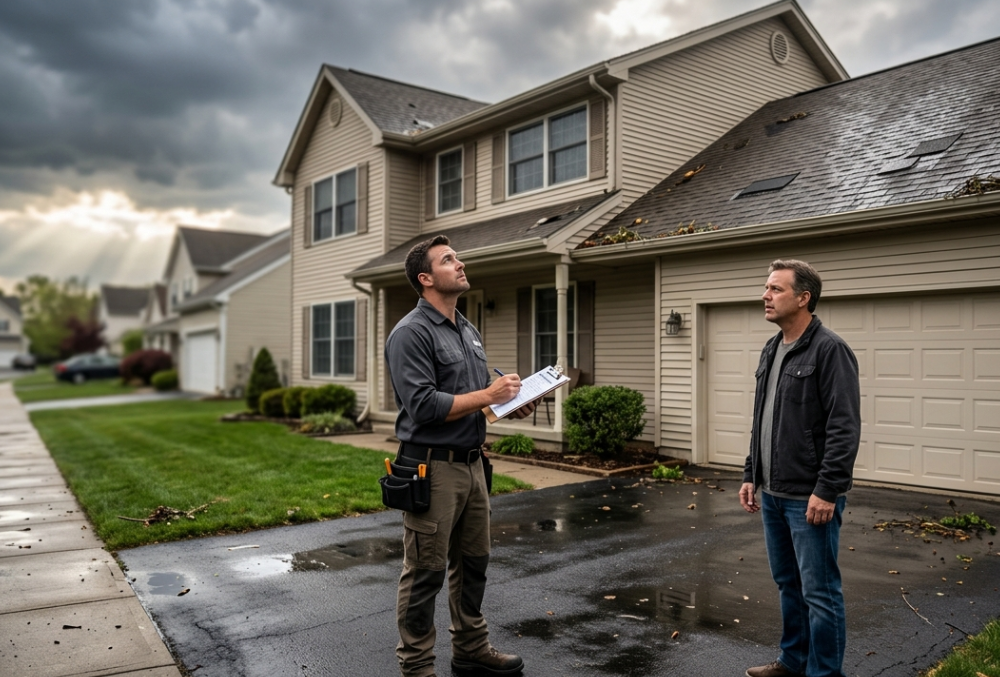
Safety first. Do not climb on your roof after a storm. Wet shingles, damaged decking, and hidden structural compromise make roof falls a leading cause of post-storm injury. Everything in this guide can be done safely from the ground and from inside your attic. If your home has active water intrusion, a tree through the roof, or a sagging roofline, call for emergency roof help before attempting any inspection.
After a nor’easter, summer thunderstorm, or hail event hits South Jersey, most homeowners do one of two things: they either assume everything is fine because nothing is visibly falling apart, or they panic and climb on the roof to look. Both are mistakes.
The reality is that most storm damage to roofs in Burlington, Camden, and Gloucester counties is not visible from the ground. According to contractor inspection data cited by GAF and Owens Corning, 50 to 70 percent of post-storm roof damage is hidden from street level. Lifted-then-resealed shingle tabs, cracked underlayment, compromised flashing, and moisture-saturated decking can all be present without a single visible sign from the yard.
This guide gives South Jersey homeowners a safe, systematic inspection sequence — from the ground and from inside — along with exactly what to photograph, how to document damage for your insurance company, and when to call a licensed local contractor rather than wait and hope for the best.
T.A. Hughes III Roofing has served Burlington, Camden, and Gloucester counties for more than 35 years. We offer free storm-damage inspections and can attend the adjuster visit with you. Request your inspection here.
South Jersey Storm Types and Why They Matter
Most storm-damage checklists online are written for national audiences. South Jersey has a specific storm profile that shapes what to look for and why it is urgent.
| Storm Type | Frequency | Wind Range | Primary Roof Risk |
|---|---|---|---|
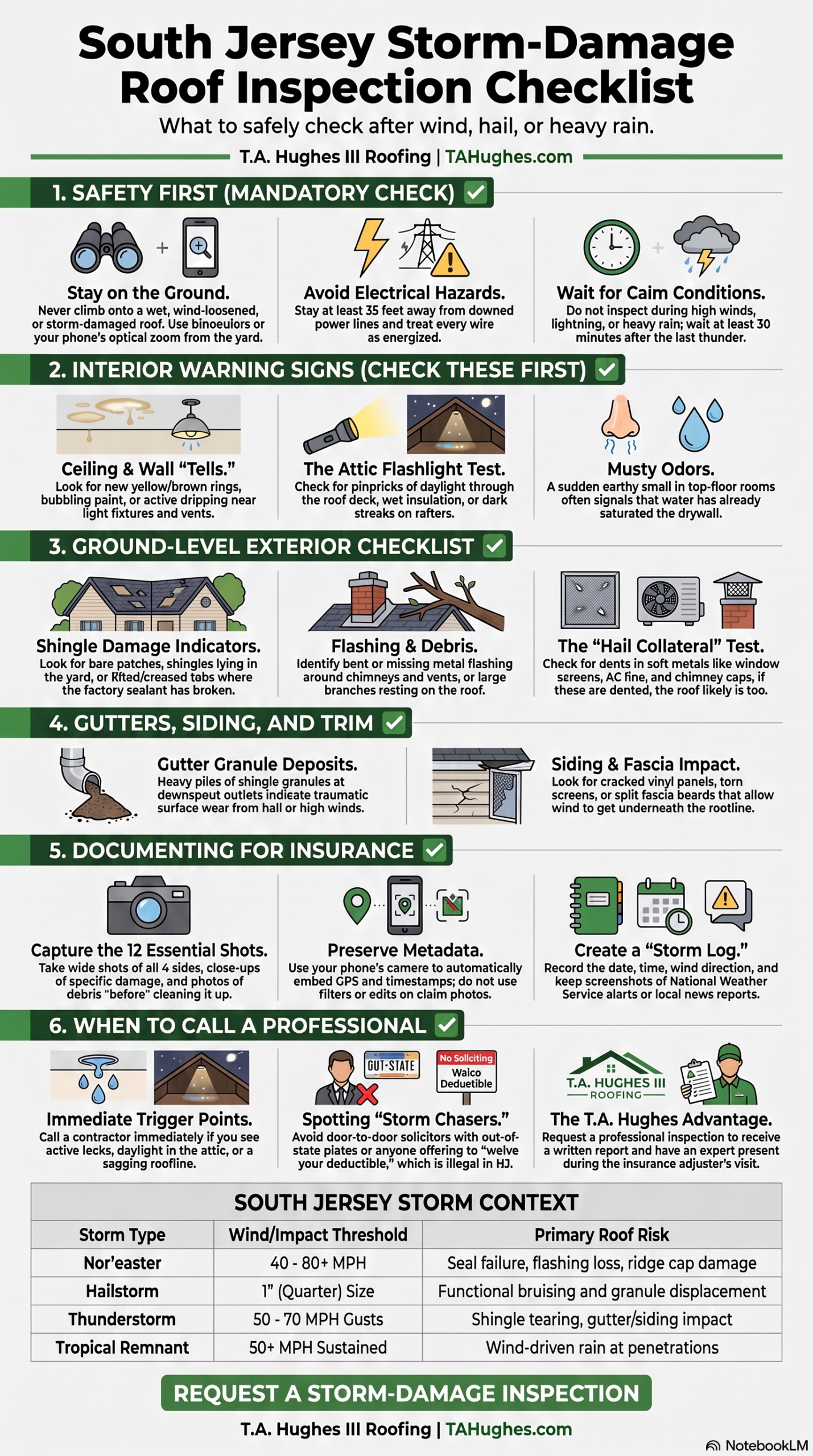
| Nor’easter | 3 to 5 per season (Oct to Apr) | 40 to 80+ mph sustained | Shingle seal failure, flashing separation, ridge cap loss |
| Severe thunderstorm / hail | ~30 NWS warnings per year | 50 to 70 mph gusts | Shingle bruising, granule displacement, gutter denting |
| Tropical remnant | 1 to 2 per season (Jun to Nov) | 50 to 80+ mph | Wind uplift on edges and ridges, wind-driven rain at penetrations |
| Derecho | Occasional (spring/summer) | 58+ mph sustained | Directional shingle loss, debris impact, structural stress |
| Winter ice / freeze-thaw | Seasonal (Dec to Mar) | N/A | Ice dam formation, shingle cracking, eave water backup |
The wind thresholds matter more than most homeowners realize. At 45 mph, a shingle’s factory sealant strip can break, leaving the tab lifted without any visible exterior sign. At 60 mph, shingles crease, tear, and begin to separate. At 70 mph and above, which is nor’easter territory in South Jersey, the damage pattern shifts from subtle to obvious. After any event in these ranges, a professional inspection is warranted even when your yard looks clean.
Before You Inspect Anything: Mandatory Safety Check
Do not proceed with any inspection until every item below is true.
| Safety Check | What It Means |
|---|---|
| Storm has fully passed | Wait at least 30 minutes after the last thunder before going outside. The National Weather Service recommends this as a minimum safe window after lightning activity. |
| No downed power lines near the property | Stay at least 35 feet from any downed wire. Treat every line on the ground as fully energized. Call 911 and your utility company (PSE&G, JCP&L, or Atlantic City Electric) from a safe distance. |
| No gas odor | If you smell rotten eggs near damaged exterior walls or meters, evacuate and call the gas company from outside. |
| No structural emergency inside | Bulging or sagging ceilings, active dripping near electrical fixtures (turn off that circuit at the breaker), or rapidly increasing water are emergencies. Call for help before inspecting further. |
| You will remain on the ground | Do not climb onto the roof. Do not place a ladder on a wet, uneven, or unstable surface. Gutter-line access is acceptable; walking the roof surface after a storm is not. |
Phase 1: The Ground-Level Exterior Walk (15 Minutes)
Walk a complete lap around your home before concentrating on any single area. Use your phone camera on full optical zoom or binoculars to see details on the roof surface. Note the direction the storm came from — the slope facing the storm typically shows the most damage.
Roof Surface Signs
| What to Look For | What It Indicates |
|---|---|
| Missing shingles or bare patches | Wind uplift exceeding the sealant bond; exposed underlayment is an active water entry point |
| Lifted or curled shingle edges, especially at rakes and ridge | Broken factory sealant; shingles may look intact but are no longer waterproof at those edges |
| Shingle pieces or fragments in the yard, driveway, or gutter | Direct confirmation of shingle loss; photograph before any cleanup |
| Dark spots or discoloration on roof surface visible through zoom | Possible hail bruising or granule displacement; needs professional confirmation |
| Displaced or missing ridge cap | Ridge cap is the most wind-vulnerable part of most roofs; loss here is both a leak risk and a warranty concern |
| Debris (branches, siding pieces, objects) on the roof | Impact damage may have punctured the deck or cracked shingles beneath; do not remove large debris yourself |
| Sagging or uneven roofline | Structural concern; call for emergency inspection before entering the home if significant |
The Hail Collateral Test — The Most Reliable Ground-Level Confirmation
If you cannot clearly see shingle damage from the ground, check soft metal surfaces around your home. Gutters, downspouts, HVAC condenser fins, chimney caps, vent covers, and window screens all dent on contact with hail. If these surfaces show circular dents and dimples, your roof almost certainly took the same impacts. This is how professional adjusters confirm hail events without needing to be on the roof first.
Hailstone size matters: one-inch hail (about the size of a quarter) can cause functional shingle damage. Two-inch hail (egg-sized) almost always produces damage requiring professional evaluation. If hail was on the ground after the storm, photograph it next to a coin or ruler before it melts.
Gutters, Siding, and Exterior Components
| Component | What to Check | Why It Matters |
|---|---|---|
| Gutters | Dents, sagging sections, joints pulled apart, sections separated from fascia | Dented gutters confirm hail impact; separated gutters allow water at the fascia and foundation |
| Downspouts | Dents, bends, separation from wall or underground drain | Blocked downspouts back water against the roof edge |
| Gutter outlets | Heavy granule accumulation at discharge points | Large granule deposits after a storm signal shingle surface damage even when shingles look intact from the street |
| Siding | Cracks, chips, dents (circular = hail; linear = debris), loose or displaced panels | Siding damage on the storm-facing elevation corroborates roof damage for the adjuster |
| Soffit and fascia | Torn or missing soffit panels, split fascia boards | Damaged soffit creates wind entry points that can lift roof sections from below |
| Windows and screens | Torn screens, cracked glass, damaged frames | Torn screens indicate wind-driven debris; cracked glass and screen damage document hail size for the claim |
| Flashing (visible from ground) | Bent, lifted, or separated metal around chimney base, skylights, or wall intersections | Even small flashing gaps become leak points. Flashing failure causes more leaks than shingle failure in South Jersey homes |
Phase 2: Interior Signs — Start Here Before the Attic
Before accessing your attic, walk every room of the house, starting at the top floor. Water that enters through a failed roof often travels along the decking and rafters before finding a low point in the ceiling — the interior stain can appear far from the actual entry point.
Living Space Signs
| What You See | What It Means | Urgency |
|---|---|---|
| New yellow or brown ceiling stain | Water has penetrated through the decking. Check whether the stain darkens after the next rain — that confirms active intrusion. Learn more about what ceiling stains mean. | Call for inspection within 24 to 48 hours |
| Bubbling or peeling paint on ceiling or upper walls | Water is pushing through from behind; the leak is active and has already saturated the drywall | Call within 24 hours |
| Active dripping near a light fixture | Turn off the circuit breaker for that area immediately. Water and electricity in contact is a fire and electrocution hazard. | Emergency — call immediately |
| Musty or earthy smell in upper rooms | Moisture has been present long enough for mold to begin; the leak may have been slow and ongoing, or the storm accelerated an existing issue | Schedule inspection within 1 week |
| Sagging or soft drywall ceiling section | Water has pooled above the drywall; do not stand under it. A sagging ceiling can collapse without warning. | Emergency — leave the room |
Phase 3: Attic Check
Access your attic only via a pull-down stair or interior hatch. Bring a flashlight. Turn off the attic light and let your eyes adjust — small pinpricks of daylight are the single most important thing to find. Each pinprick is a confirmed hole in the decking where water has a path in.
| What to Look For | What It Signals |
|---|---|
| Daylight visible through the roof deck | Confirmed hole or gap. Call for emergency tarping. Photograph immediately. |
| Dark streaks, rings, or staining on rafters and underside of decking | Water trails showing where moisture has run. The entry point is typically uphill from the stain. |
| Wet, compressed, or discolored insulation | Active or recent water intrusion. Wet fiberglass insulation holds moisture and accelerates decking rot. Learn why decking condition matters. |
| Rusted nail tips with moisture droplets | Chronic attic moisture, possibly pre-existing. Confirm with the contractor whether this predates the storm. |
| Mold spotting on wood surfaces | Moisture has been present long enough to colonize. Requires remediation alongside roof repair. |
| Wet spots near chimney base, vents, or valleys | Flashing failure at penetrations, which is the most common South Jersey leak source. Mark the location with chalk or tape before the contractor arrives. |
Phase 4: What to Photograph — The 12 Shots That Support a Claim
Take these photos before you move any debris, clean any gutters, or apply temporary repairs. Phone photos automatically embed date and GPS metadata in the image file — this is admissible insurance documentation. Do not screenshot or re-export to other apps, as that strips the metadata.
| Shot | What to Capture | Why Adjusters Want It |
|---|---|---|
| 1. Wide exterior (x4) | One wide shot of each side of the home from the street or yard | Establishes baseline condition; prevents adjuster argument that damage was pre-existing |
| 2. Roof slope views (x2) | Zoom shots of the storm-facing slope and any visible damage areas from the ground | Shows damage pattern and affected area; directional damage supports the storm claim |
| 3. Debris in place | Shingle pieces, branches, or debris on the ground or roof before you touch anything | Proves storm event and documents what material came off the roof |
| 4. Hail evidence | Hail on the ground beside a ruler or coin; dents in gutters, AC fins, or downspouts | Establishes hailstone size and confirms the event hit your property specifically |
| 5. Siding and gutter damage | Close-ups of dents, cracks, separations — wide context shot plus macro detail | Corroborates roof damage claim; adjusters use collateral damage to verify storm direction and intensity |
| 6. Interior ceiling stains | Every new stain in every room; include the ceiling light fixture for scale reference | Proves interior damage has occurred; ties interior water entry to the storm event |
| 7. Attic moisture | Any daylight through decking, wet insulation, dark rafters, or moisture staining | Shows damage already present inside the structure before the adjuster visits |
| 8. Storm context screenshot | Screenshot of the NWS warning alert or local news coverage showing the storm date and type | Ties your documented damage to a specific weather event on record; use the NOAA Storm Events Database to confirm your storm is logged |
Back up all photos to cloud storage immediately — iCloud, Google Photos, or Dropbox. Phones can be damaged or lost in storm events. Cloud copies with embedded metadata survive even if your device does not. Do not apply filters or edits to any photo you plan to submit with a claim.
What a Low Quote Is Hiding: The Storm Chaser Warning
South Jersey has a documented storm chaser problem. After every major nor’easter or hail event, crews from out of state canvass affected neighborhoods offering fast inspections and deep discounts. The goal is to get a signed contract quickly, before you can verify who they are or compare estimates.
| Red Flag | Why It Matters |
|---|---|
| Unsolicited door-knock immediately after the storm | Legitimate local contractors do not canvas neighborhoods. If they showed up at your door, they likely drove in from another state. |
| Offer to “waive your deductible” | This is insurance fraud in New Jersey. The contractor inflates the claim or cuts material quality to cover your deductible. Never accept this offer. |
| No NJ HIC registration number | Every contractor performing home improvement work in New Jersey must be registered with the NJ Division of Consumer Affairs. Verify at njconsumeraffairs.gov/hic before signing anything. |
| Request to sign an Assignment of Benefits (AOB) | An AOB transfers your insurance claim rights to the contractor. Once you sign, you lose control over the payout, the materials, and the scope of work. Do not sign one. |
| No local address or multi-year local review history | A contractor with no verifiable local presence cannot honor a warranty if they leave after the season. Check Google reviews for multi-year history, not just post-storm reviews. |
| Pressure to sign today | Any legitimate contractor will give you time to verify their registration, check references, and compare written estimates. Urgency is a sales tactic, not a reality. |
T.A. Hughes III Roofing holds an active NJ HIC registration and has served Burlington, Camden, and Gloucester counties for more than 35 years. Our roofing scam guide covers every red flag in detail.
Insurance Documentation: The 72-Hour Framework
Most NJ homeowners policies require “prompt” notification after a loss. A practical framework:
| Window | What to Do |
|---|---|
| 0 to 24 hours | Safety check, interior inspection, ground-level walk, photograph everything in place before any cleanup. If there is active water intrusion, call T.A. Hughes for emergency tarping. |
| 24 to 72 hours | Call your insurance carrier’s claims line (not your agent — the claims line opens the formal claim). Get a claim number and adjuster contact. Do not authorize permanent repairs before the adjuster inspects. |
| Within 1 week | Schedule your free T.A. Hughes storm-damage inspection. We attend the adjuster meeting with you, document conditions professionally, and provide a written report your carrier can use. |
| Adjuster visit | Be present. Walk the property together. Have your contractor there to point out every damage area documented in your photos. Adjusters who inspect alone miss things. |
Know your deductible before you file. NJ homeowners policies often carry a separate wind and hail deductible of 1 to 5 percent of Coverage A (your dwelling value) rather than a flat dollar amount. On a $400,000 home, a 2 percent wind deductible equals $8,000. Filing a claim for damage that falls below your deductible creates a claims history without a payout. Ask your agent to confirm your deductible structure before calling the claims line. For a full breakdown of how NJ roof insurance claims work, read our insurance guide.
Keep these records in one folder from the moment you call the carrier:
- Insurance policy number and carrier emergency line
- Claim number and adjuster name
- All photographs and videos (originals, not screenshots)
- Storm date and NWS confirmation screenshot
- Receipts for any emergency tarping or temporary repair materials
- Written contractor inspection report
- Written correspondence with the insurer
- Copies of all estimates
The New Jersey Department of Banking and Insurance advises retaining damaged property where possible until the adjuster inspects, photographing damaged items before disposal, and making only reasonable temporary repairs to prevent additional loss. Receipts for those repairs are typically reimbursable. Review current NJDOBI claims guidance for the most current homeowner protections.
When to Call T.A. Hughes Today — Not Next Week
Some situations require same-day professional help. Do not wait for the adjuster’s schedule or the next available appointment if you see any of these:
| Condition | Why It Cannot Wait |
|---|---|
| Active water intrusion inside the home | Every hour increases interior damage, decking saturation, and mold risk |
| Daylight visible in the attic | Confirmed structural opening; emergency tarping needed before the next rain |
| Tree or branch on or through the roof | Dead weight stressing the structure; do not attempt to remove it yourself |
| More than a few missing shingles | Every hour of exposed underlayment is potential leak time during the next rainfall |
| Sagging roofline visible from the street | Structural compromise; the home may not be safe to occupy until evaluated |
| You plan to file an insurance claim | A professional written report from T.A. Hughes gives your claim stronger documentation than homeowner-taken photos alone |
What a T.A. Hughes Storm-Damage Inspection Covers
A professional inspection is not just a ground-level walk. Here is what happens when T.A. Hughes inspects your South Jersey home after a storm:
- Full roof surface access with appropriate fall protection — we walk the slope, not just the perimeter
- Shingle-by-shingle assessment: lifting tabs to check sealant integrity and underlayment condition underneath
- Flashing condition at all chimneys, skylights, valleys, pipe boots, and wall intersections
- Ridge cap, drip edge, and starter strip evaluation
- Attic inspection for daylight, moisture staining, wet insulation, and decking condition
- Gutter and soffit assessment for hail impact and wind damage
- Siding and window documentation for collateral damage evidence
- Written damage report with photographs at every point — formatted for insurance adjuster review
- Adjuster meeting attendance upon request
We do not publish what T.A. Hughes charges for repairs — because a legitimate post-storm quote requires seeing the actual conditions of your specific roof. Any contractor who quotes you a number over the phone without an inspection is guessing. Learn more about what happens during a professional roof inspection.
Frequently Asked Questions
How do I check my roof for storm damage without climbing on it?
Walk the full perimeter of your home using binoculars or your phone camera on optical zoom. Look for missing or lifted shingles, debris in the yard, granules at downspout outlets, and dented gutters or soft metals. Then check the attic with a flashlight for daylight, moisture staining, and wet insulation. Then walk every ceiling inside the home. That sequence covers most of what matters from a safe position.
What does hail damage look like on a roof?
The most reliable ground-level signs are dents on soft metals around your home — gutters, AC condenser fins, vent caps, chimney caps, and window screens. On shingles, hail leaves roughly circular dark spots where granules have been displaced and the black asphalt mat beneath is exposed. A bruised shingle feels soft when pressed with a gloved finger, similar to a bruise on fruit. Hail damage is randomly distributed across all roof slopes, unlike wind damage, which concentrates on the storm-facing side.
What does wind damage on a roof look like?
Wind damage concentrates at the edges, ridge, and hips — anywhere wind can get underneath and create uplift. Look for missing shingles, lifted or curled tab edges, creased shingles that are still attached but damaged, exposed nail heads, displaced ridge cap, and bent flashing at chimneys and walls. The slope that faced the wind shows the most visible damage; the sheltered slope often looks fine.
Do I need a permit for storm damage repairs in South Jersey?
It depends on the scope. Simple shingle-for-shingle replacement on a detached one or two-family home may qualify as ordinary maintenance under New Jersey code. But if decking is replaced, structural work is done, or the property is a townhome or condo, a permit is typically required. A licensed NJ contractor will know what applies to your specific repair and property type. Read more in our NJ permit guide.
Should I file an insurance claim for every storm?
Not always. First determine whether the damage exceeds your deductible. NJ wind and hail deductibles can be 1 to 5 percent of your dwelling value — on a $400,000 home that is $4,000 to $20,000. If the repair cost is below your deductible, filing creates a claims history with no financial benefit and can affect your renewal rate. Get a written estimate from a licensed contractor before deciding whether to file.
Can I apply a tarp myself after a storm?
You can tarp a flat or low-slope roof from the ground using a pole in some cases, but do not climb onto a storm-damaged roof to install a tarp. DIY tarps installed without proper anchoring typically fail within one rain event. T.A. Hughes installs heavy-duty emergency tarps rated for 30 to 90 days with proper anchoring. Emergency tarping costs are typically reimbursable by insurance — keep all receipts. More detail in our emergency roofing guide.
How long after a storm can I wait to file an insurance claim?
Do not wait. Most NJ homeowners policies require prompt notification, and many have contractual claim deadlines of one year from the date of loss. Practically speaking, earlier claims produce better outcomes: the documentation is cleaner, the adjuster schedule is shorter, and hidden damage has not had time to compound. Call the insurance claims line within 48 to 72 hours of the storm even if you are still assessing the scope.
What is a certificate of appropriateness and does it apply to my roof?
Homeowners in South Jersey historic districts — including areas of Haddonfield and Cape May — may need a Certificate of Appropriateness from the local Historic Preservation Commission before authorizing permanent roof repairs. Emergency tarping is generally permitted without prior approval, but material selection and replacement methods require review. If your home is in a historic district, mention this when you call T.A. Hughes so we can account for it in the inspection scope.
Request Your Free Storm-Damage Inspection
You documented the warning signs from the ground. Now let T.A. Hughes assess what you cannot safely see. We inspect the full roof surface, the attic, all flashing points, and the gutters, then deliver a written report with photographs your insurance company can use. We attend the adjuster meeting upon request.
Request a Free Storm-Damage Inspection
T.A. Hughes III Roofing serves homeowners across Gloucester County, Burlington County, and Camden County, including Deptford, Cherry Hill, Voorhees, Marlton, and Washington Township. We offer emergency roof repair for active leaks and residential roofing services including replacement, repair, and gutter repair. Financing is available.
This guide is for safe homeowner observations from the ground and interior of the home. It is not a professional roof inspection, structural evaluation, or insurance-coverage determination. Never climb onto a wet, damaged, or storm-compromised roof.