
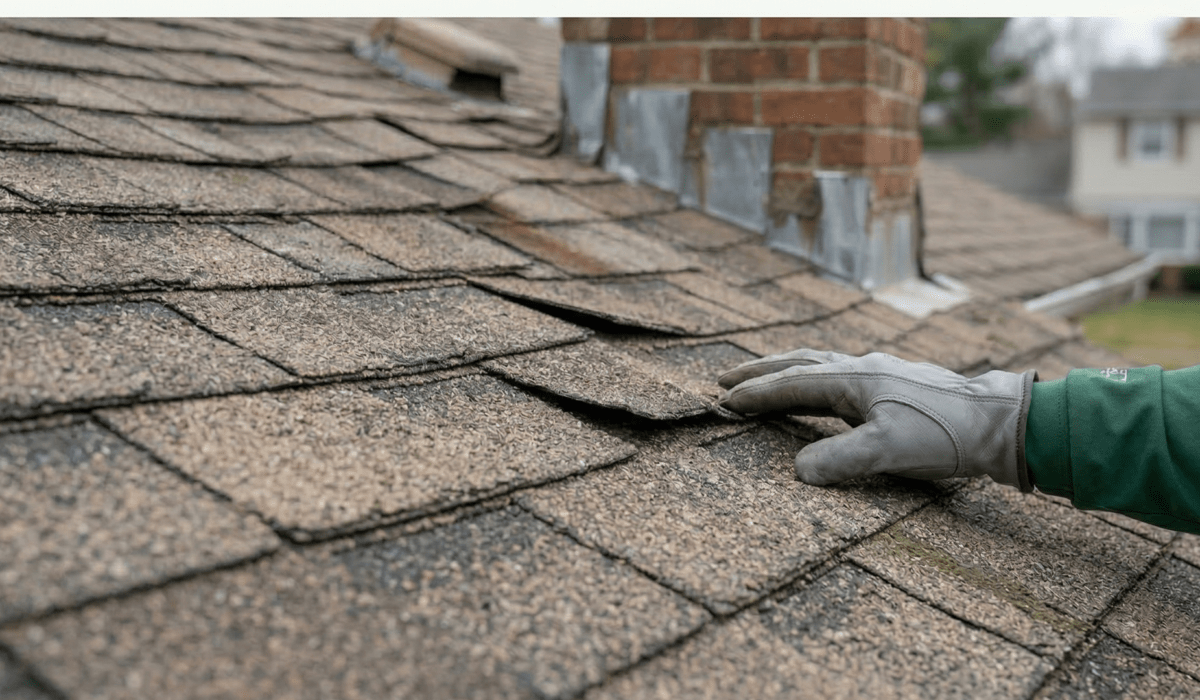
What Causes Roof Shingles to Curl or Lift?
Roof shingles curl or lift due to a combination of age-related material breakdown, poor attic ventilation, moisture imbalance within the shingle itself, improper installation, and wind damage. In South Jersey, where summer heat, humidity, and seasonal storms put consistent stress on roofing systems, curling and lifting are among the most reliable visual indicators that a roof is approaching or past the end of its useful life — or that an underlying system problem needs attention.
Key Takeaways
- Curling and lifting are not the same condition and do not always have the same cause
- Poor attic ventilation is one of the most common and underrecognized contributors to shingle curling on South Jersey homes
- Shingles installed over an existing layer of old roofing are more prone to curling due to trapped heat and uneven surface contact
- Wind lifting that does not result in missing shingles can still break the sealant bond, leaving the roof vulnerable to water entry
- Curling or lifting across multiple sections of a roof typically signals the system as a whole is failing, not an isolated repair situation
Curled or lifted shingles are one of the exterior problems homeowners can sometimes see from the yard — a rippled edge here, a raised corner there. What they often cannot see is why it is happening or what it means for the roof beneath.
The answer matters because curling and lifting have different causes, carry different implications, and in some cases point to underlying system problems that replacing the affected shingles alone will not resolve. Understanding the distinction helps homeowners ask the right questions and make informed decisions when they have the roof evaluated.
Curling vs. Lifting: Understanding the Difference
These terms are sometimes used interchangeably, but they describe different conditions with different causes.
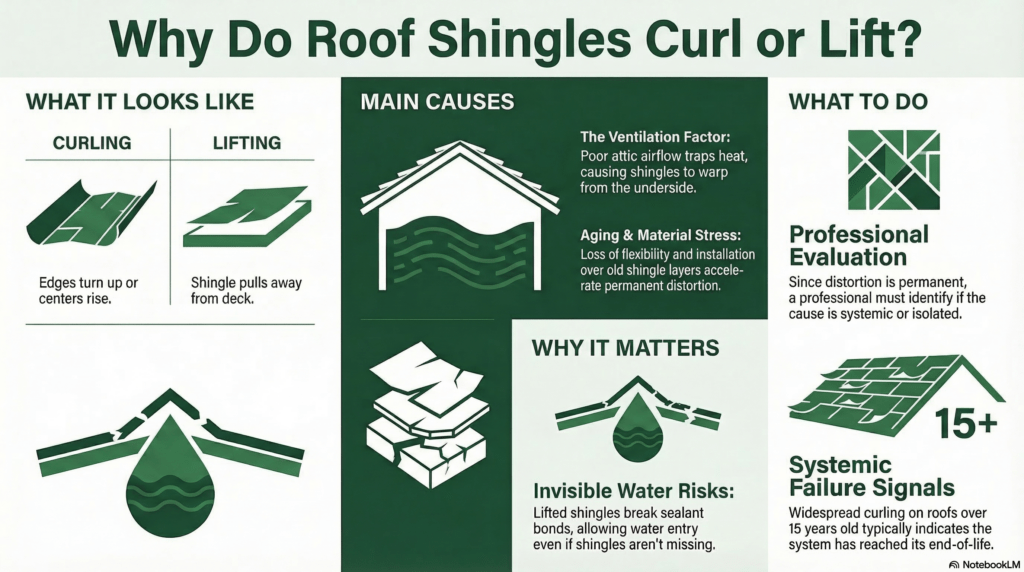
Curling refers to distortion within the shingle itself — the shingle body warps, bends, or changes shape over time. There are two distinct forms:
- Cupping occurs when the edges of a shingle turn upward while the center remains flat or sinks downward, creating a concave shape across the shingle surface. It is typically associated with moisture imbalance and aging.
- Clawing occurs when the edges stay flat but the middle of the shingle begins to rise, creating a convex surface. It is more commonly associated with age-related material hardening and loss of flexibility.
Lifting refers to a shingle — or section of shingles — that has physically separated from the surface beneath it, typically at a corner or along an edge, without significant distortion of the shingle body itself. Lifting is most commonly associated with wind damage, sealant strip failure, or inadequate fastening.
Both conditions compromise the roof’s ability to shed water and resist wind. But the underlying cause — and the appropriate response — differs between them.
What Causes Shingles to Curl
Cause 1: Poor Attic Ventilation
This is the most common and most frequently overlooked cause of shingle curling on South Jersey homes — and one of the most consequential.
A properly ventilated attic maintains airflow that moderates temperature and moisture levels in the space directly below the roof decking. When ventilation is inadequate — whether from insufficient intake vents, blocked soffits, or exhausted ridge vent capacity — heat and moisture accumulate in the attic.
That accumulated heat radiates upward through the decking and into the underside of the shingles. Shingles that are repeatedly heated from below and cooled from above — day after day across South Jersey’s warm seasons — experience uneven thermal stress that distorts the material over time. The result is cupping and curling that originates not from the weather above but from the conditions below.
This matters because replacing curled shingles without correcting the ventilation problem produces the same result on the new shingles. The curling recurs because the cause was never addressed.
On many South Jersey homes built in the 1980s and 1990s, attic ventilation systems were installed to standards that are now considered insufficient. Blocked soffit vents — often covered by insulation added during energy upgrades — are a particularly common finding that creates exactly these conditions.
Cause 2: Moisture Imbalance Within the Shingle
Asphalt shingles are manufactured with a specific moisture content. When the underside of a shingle absorbs moisture at a different rate than the top surface — which is sealed and weather-exposed — the two layers of the shingle expand at different rates. This differential expansion causes the shingle to cup, with edges pulling upward as the bottom expands more than the top.
The moisture that causes this imbalance can come from several sources:
- High humidity in an inadequately ventilated attic working up through the decking
- Moisture already present in the roof decking when shingles were installed
- Water intrusion from a separate source — a flashing failure, a failed pipe boot — that has allowed moisture to reach the underside of the shingle
Once cupping has developed from moisture imbalance, it does not reverse when the moisture dissipates. The distortion is permanent, and the affected shingles need replacement. More importantly, the moisture source that caused the imbalance needs to be identified and addressed or the condition will repeat.
Cause 3: Age and Material Hardening
As asphalt shingles age, the oils and polymers that give the material its flexibility gradually break down. The shingle becomes stiffer and more brittle. As this process advances, the shingle loses its ability to lie flat under thermal stress — it begins to distort along its edges and across its surface in ways that a newer, more flexible shingle would not.
This form of curling — typically clawing — tends to be widespread across the shingle field rather than isolated to one area. It appears gradually over several years and accelerates as the shingle approaches the end of its serviceable life.
In South Jersey, where UV exposure is significant across the warm months, shingle material breakdown happens consistently with age. On homes from the 1980s and 1990s where the original roof has never been replaced, clawing across the field is a common finding that signals the system is in its final years of service.
Cause 4: Shingles Installed Over Existing Layers
In many South Jersey homes, a second layer of shingles was installed over the original rather than tearing off the old roof completely. This is a common practice — sometimes acceptable depending on conditions — but it creates specific vulnerabilities related to curling.
Old shingles beneath a new layer are not flat. Curled, cupped, or wavy shingles from the original layer create an uneven surface that the new shingles cannot lie flat against. The new shingles conform partially to the irregular surface beneath them, creating built-in distortion from installation day.
Additionally, shingles installed over an existing layer trap more heat. The old shingles add thermal mass that slows the dissipation of heat from the roof surface, subjecting the upper layer to higher sustained temperatures than a single-layer roof would experience.
When curling appears relatively early on a roof — within 8 to 12 years of installation rather than 20 or more — an existing underlayer is one of the first things a professional inspection should assess.
Cause 5: Manufacturing Defects or Material Quality
Less common but worth noting: some shingles curl prematurely due to manufacturing inconsistencies in the asphalt compound, the fiberglass mat, or the coating process. This tends to produce curling that appears earlier than expected — within the first several years — and often affects specific batches or product lines rather than the roof as a whole.
If curling is present on a roof that is substantially newer than the typical age at which these conditions appear, and no installation or ventilation issues are identified, a manufacturing defect may be worth investigating, particularly if the roof is still within its warranty period.
What Causes Shingles to Lift
Cause 1: Wind Damage
Wind is the most direct cause of shingle lifting. Asphalt shingles rely on two mechanisms to stay in place: mechanical fastening through nails or staples, and a factory-applied sealant strip along the lower edge that bonds to the shingle above it once the roof warms after installation.
When wind gets beneath the leading edge of a shingle — particularly at the eaves, rakes, and ridge, where exposure is greatest — it exerts uplift pressure. Shingles with an intact sealant bond resist this pressure. Shingles whose sealant bond has weakened with age, or that were never fully bonded due to installation in cold weather, are more vulnerable.
After a significant wind event in South Jersey — a Nor’easter, a severe summer thunderstorm, sustained gusts from a coastal system — lifted shingles are a consistent inspection finding. The critical point is that lifted shingles do not need to be missing to create a problem. A shingle that has been lifted and returned to approximately its original position may appear intact from the ground while its sealant bond is broken and its fasteners are compromised. Water can now enter at that location during rain.
This is why post-storm inspections in South Jersey are recommended even when no shingles appear obviously missing from the yard.
Cause 2: Fastener Problems
Shingles that were under-fastened at installation — too few nails, nails placed too high on the shingle rather than in the designated nailing zone, or nails that did not penetrate the decking adequately — are more vulnerable to lifting under wind pressure from the start.
Fastener problems are a latent installation issue that may not produce visible lifting for years. The shingles perform adequately under normal conditions but lift under wind loads that a properly fastened shingle would resist. This pattern — lifting only in significant wind events, returning to position when wind subsides — is a useful indicator of a fastening issue when it occurs on a relatively newer roof.
Cause 3: Sealant Strip Failure With Age
The factory-applied sealant strip on an asphalt shingle is designed to activate when the shingle warms after installation, bonding it to the shingle course below. Over time, that bond weakens as the asphalt-based sealant ages and loses adhesion.
On roofs 20 years or older in South Jersey, sealant strip degradation is expected. Shingles that were securely bonded for the first decade or more of their service life gradually lose that bond, making them increasingly susceptible to lifting under wind pressure that they previously would have resisted.
This is one reason why an older roof may develop wind lifting problems after storms that the same roof handled without incident for years earlier in its life. The shingles have not changed in appearance, but the bond holding them down has weakened.
What Curling and Lifting Actually Mean for Your Roof
The significance of curled or lifted shingles depends on how widespread they are, the age of the roof, and what else the inspection finds.
Isolated lifting at a few corners or edges after a specific wind event on a roof that is otherwise sound and mid-life may be a targeted repair situation — resetting and re-sealing affected shingles and assessing fastener condition in those areas.
Curling that is isolated to one section warrants investigation into whether there is a local ventilation issue, a moisture source beneath that section, or an underlayer problem in that area. Replacement of the affected section and correction of the cause may be appropriate.
Widespread curling across multiple sections of the roof — particularly on a roof that is 18 years or older — is a system-level indicator. It typically means the shingles have aged past the point where isolated repairs are the right approach. A full evaluation of the roof’s remaining useful life and the condition of all components is warranted.
Curling combined with significant granule loss, flashing failures, and ventilation problems indicates a roof that has reached the end of its serviceable life as a system. At that point, replacing individual components addresses symptoms without addressing the condition.
Does Curling or Lifting Mean the Roof Needs to Be Replaced Immediately?
Not always — but it warrants prompt evaluation rather than monitoring from the yard.
Curled or lifted shingles that remain in place are still providing some degree of coverage. But they are no longer providing the weather resistance they were designed to deliver. Each rain event, wind event, and freeze-thaw cycle that affects curled or lifted shingles accelerates the deterioration of both the shingles themselves and the components beneath them.
The practical question is not whether the roof still has some coverage — it is whether the coverage is adequate for the conditions it faces, and how much time remains before failures become active leaks or structural moisture damage.
A professional inspection gives you an accurate answer to that question based on actual conditions rather than assumptions.
Frequently Asked Questions
Can curled shingles be flattened back down? No. Once a shingle has curled or cupped, the distortion is permanent. Attempting to flatten them risks cracking the material. Curled shingles need to be replaced, and the underlying cause needs to be identified and corrected.
Is it normal for shingles to lift slightly at the edges in cold weather? Some minor stiffening and edge movement in very cold weather is normal for asphalt shingles. Persistent lifting that does not return to a flat position as the roof warms, or lifting that leaves a visible gap along the edge, warrants evaluation.
How much wind does it take to lift shingles? Properly installed shingles with intact sealant bonds are rated for specific wind speeds depending on the product. As roofs age and sealant bonds weaken, effective wind resistance decreases. Shingles that lift in moderate wind events are typically indicating age-related sealant failure rather than inadequate original installation.
If I see a few curled shingles, how urgently should I act? The urgency depends on how widespread the curling is and what else is present. A handful of curled shingles on a roof that is otherwise sound warrants scheduling an inspection — not an emergency call. Widespread curling across the field, particularly on an older roof, warrants prompt evaluation before active leaks develop.
Does my homeowner’s insurance cover curling shingles? Age-related curling is typically not covered, as it reflects normal material deterioration rather than storm damage. Wind lifting caused by a specific storm event may be covered depending on your policy. A professional inspection documents findings accurately — coverage decisions belong to you and your carrier.
What to Do if You’re Seeing Curled or Lifted Shingles
If curled or lifted shingles are visible from the yard — or if your South Jersey home has a roof that is 15 years or older and has not been professionally evaluated recently — an inspection is the right next step.
A thorough inspection will identify the cause of the curling or lifting, evaluate the condition of the full roofing system, and give you an accurate picture of what your roof actually needs — without assumptions in either direction.
T.A. Hughes III Roofing offers free, no-obligation roof inspections for homeowners throughout Burlington, Camden, and Gloucester Counties.
Schedule a free inspection to get a clear, honest assessment of your roof’s condition.
T.A. Hughes III Roofing is a family-owned exterior remodeling contractor serving South Jersey for over 45 years. The company is fully licensed and insured in the State of New Jersey and holds GAF Certified Roofing Contractor status.