
Why Do Small Roof Leaks Get Worse Over Time?
Small roof leaks worsen over time because water is persistent, cumulative, and destructive to the materials it contacts repeatedly. What begins as a slow entry at a failed flashing joint or a cracked pipe boot gradually saturates decking, weakens framing, compromises insulation, and creates conditions for mold — all before most homeowners have any visible interior sign that something significant is happening. In South Jersey, where seasonal storms, humidity, and freeze-thaw cycles keep roofing systems under consistent stress, small leaks that go unaddressed rarely stay small.
Key Takeaways
- A slow roof leak causes more total damage than most homeowners expect because the damage accumulates invisibly over multiple seasons
- Water degrades roofing materials in a specific sequence — from decking outward — and each stage of damage makes the next stage more likely
- Mold can begin developing in a wet attic environment within 24 to 48 hours under the right conditions
- The cost of addressing a small leak at discovery is almost always substantially lower than addressing the secondary damage it produces if left alone
- South Jersey’s weather cycles — particularly freeze-thaw in winter and humidity in summer — accelerate the damage progression that a slow leak causes
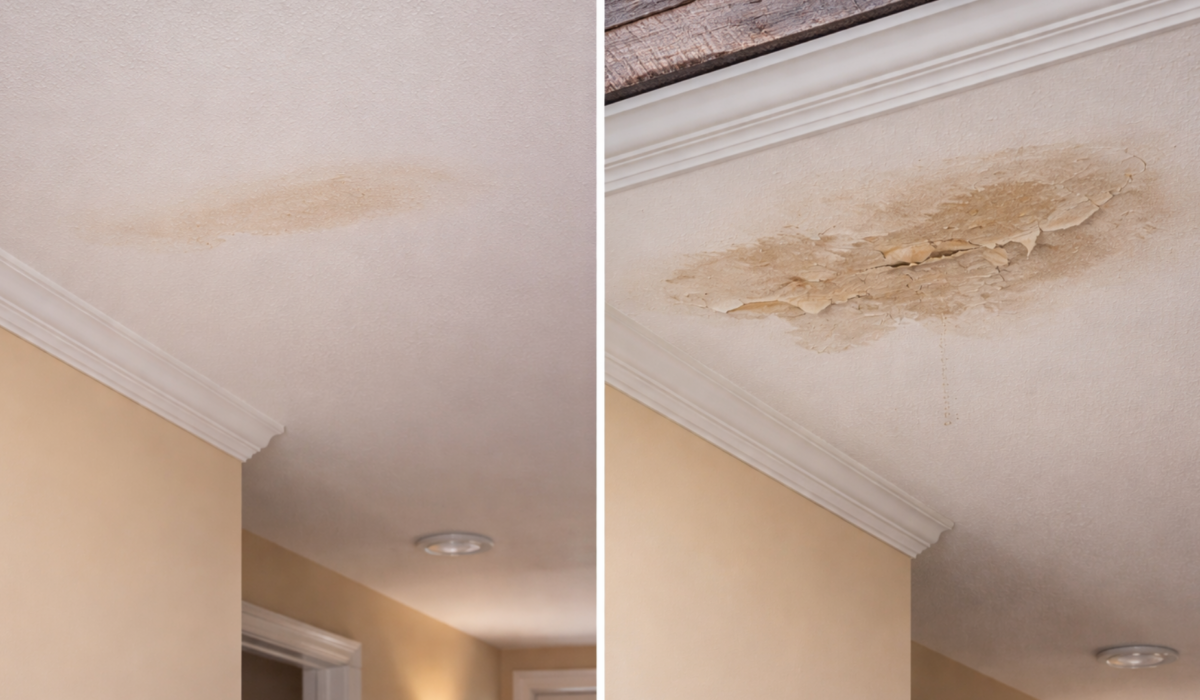
The phrase “small leak” carries a misleading sense of proportion. A leak that produces a faint ceiling stain or an occasional drip during heavy rain feels minor. It is not visibly urgent. There is no obvious emergency. It goes on the list of things to address eventually.
Meanwhile, beneath the ceiling and behind the walls, the water that produced that stain has been doing something far less minor for weeks or months — or longer.
Understanding what a small leak actually does over time, and why the timeline from minor issue to significant structural damage is shorter than most homeowners assume, is one of the most practical things a South Jersey homeowner can know about their roof.
What “Small” Actually Means in Roofing Terms
In roofing, the word “small” typically describes what the homeowner can see — a faint stain, an occasional drip, a leak that only appears in heavy storms. It does not describe what is happening inside the roof assembly.
A leak that produces a quarter-sized ceiling stain may have been slowly saturating a two-foot section of decking, wicking into a rafter, and spreading across insulation for an entire season before that stain appeared. The interior evidence is the last thing to show up — not the first.
This is the central problem with assessing a leak by what it looks like from inside the house. What appears small from below is almost always larger above.
How a Small Leak Progresses: The Damage Sequence
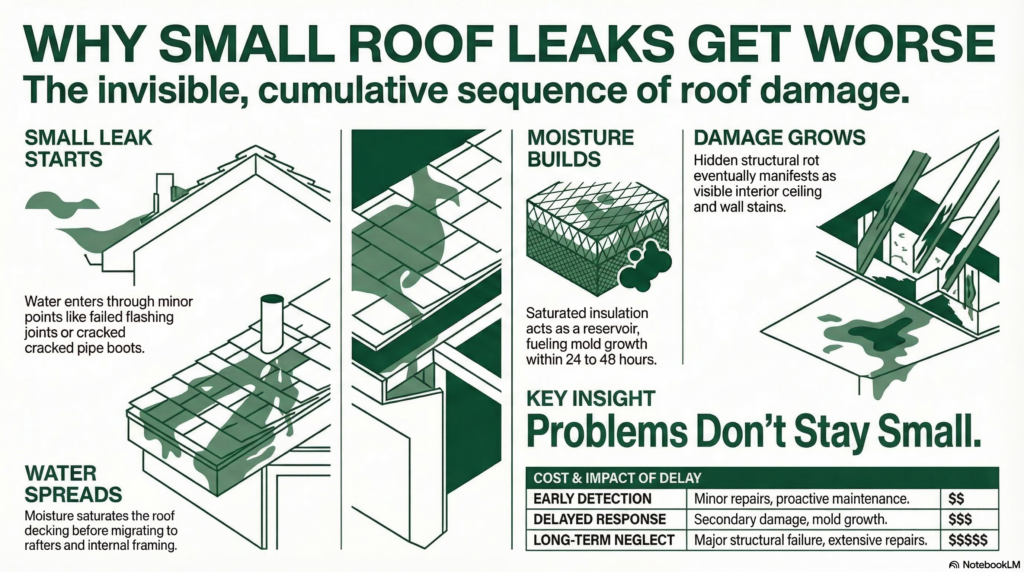
Roof leak damage follows a predictable sequence. Each stage weakens the materials involved and creates conditions that accelerate the next stage. Understanding the sequence explains why waiting does not preserve options — it narrows them.
Stage 1: Decking Saturation
The first material water contacts after entering the roof assembly is the roof decking — the plywood or OSB board that shingles are fastened to. Decking is engineered wood, which means it is vulnerable to moisture in a specific way.
Plywood and OSB absorb water into the wood fiber and adhesive layers that hold them together. A single wetting and drying cycle causes minor swelling and some fiber damage. Repeated cycles — water enters during rain, partially dries between events, enters again — cause cumulative delamination, where the layers begin to separate. The decking softens progressively. Fastener holding strength decreases. The structural integrity that the entire roofing system depends on begins to degrade.
On a roof with a slow leak, this process unfolds over seasons rather than days. The decking may appear intact — no visible sag, no soft spot accessible from below — while significant moisture damage has accumulated within the material. By the time a soft spot is detectable from the attic side, the decking in that area typically needs replacement rather than drying out.
In South Jersey, where summer humidity keeps moisture levels elevated even between rain events, decking in a leaking roof section dries more slowly than it would in a drier climate. The damage accumulates faster as a result.
Stage 2: Rafter and Framing Exposure
Water that saturates decking does not stay contained within the panel. It migrates to the edges, runs along the surface, and contacts the rafters and other framing members the decking sits on.
Wood framing exposed to repeated moisture cycling develops surface mold first, then deeper mold penetration, then early rot if moisture exposure continues long enough. Structural lumber that has been repeatedly wetted and dried across multiple seasons loses measurable strength — not immediately and dramatically, but progressively in ways that matter when that lumber is supporting the load of a roofing system.
The important point is that rafter and framing damage from a roof leak is not visible from the living space below under ordinary circumstances. It is found during an attic inspection when a contractor looks directly at the framing. Homeowners who have never had an attic inspection on an older South Jersey home — particularly one where a stain has appeared on the ceiling at some point — sometimes discover framing damage they had no reason to suspect.
Stage 3: Insulation Degradation
As water travels past decking and framing, it reaches the insulation layer in the attic. Insulation responds to moisture in two ways that cause lasting problems.
Compressed and matted insulation loses its thermal effectiveness. Fiberglass batts that have been wetted and dried flatten and compact, reducing R-value. Blown-in insulation clumps and settles unevenly. The home becomes less energy efficient from that point forward regardless of whether the leak source is addressed, because degraded insulation does not recover its original performance when it dries.
Saturated insulation becomes a reservoir. A thick batt of fiberglass or a deep layer of blown-in insulation can hold a significant volume of water, releasing it slowly over days after a rain event ends. This prolonged moisture release keeps the decking and framing above it damp well beyond the rain event itself — extending exposure time and accelerating the cumulative damage at those levels.
Homeowners sometimes find that a ceiling stain appears or grows days after a rain event has passed, which is often the insulation releasing stored moisture rather than active water entry.
Stage 4: Mold Development
Mold requires three things to develop: a food source, moisture, and the right temperature. In an attic with a slow leak, all three are present.
Wood and paper-faced materials are food sources. Moisture from the leak provides the water. Attic temperatures in South Jersey — warm in summer, moderately cool in winter — fall within the range that supports mold growth across most of the year.
Under suitable conditions, mold can begin developing on wet surfaces within 24 to 48 hours. A slow leak that has been active across multiple rain events over a season creates conditions where mold establishment is not a possibility — it is a near-certainty if the moisture is not dried out and the source addressed promptly.
Mold in an attic is not always immediately visible or detectable from the living space. It grows on the underside of decking, on rafter surfaces, and within insulation. The first sign many homeowners encounter is a musty odor in the home — by which point the mold is already established across an area that requires remediation, not simple cleaning.
Mold remediation in a residential attic is a separate scope of work from roofing repair. It carries its own cost and its own timeline. A small leak that was addressed as a roofing problem in its early stages becomes a roofing problem plus a mold remediation problem if it is allowed to progress.
Stage 5: Interior Material Damage
Eventually — after water has traveled through decking, along framing, and through insulation — it reaches the ceiling and wall materials of the living space below.
Drywall absorbs water readily and loses structural integrity as it does. Wet drywall develops staining, then softening, then crumbling. Ceiling drywall that has been repeatedly wetted eventually fails — it sags, develops visible cracks along tape joints, and in advanced cases drops material. Plaster ceilings in older South Jersey homes develop similar patterns: staining and crumbling plaster in areas that have experienced repeated moisture cycles.
Wall cavities that receive water from a failed flashing at a dormer or wall transition can develop insulation and framing damage similar to what occurs in the attic — contained behind finished wall surfaces where it is invisible until a repair requires opening the wall.
Stage 6: Secondary Structural Damage
In cases where a slow leak has been active for years without detection — which happens more often than most homeowners expect — the damage sequence can extend to structural components beyond the rafters.
Ridge beams, collar ties, and wall top plates that have been in chronic moisture contact develop progressive rot. Fastener connections between structural members corrode. In extreme cases, load-bearing capacity is affected.
This stage of damage is uncommon in homes where leaks are eventually identified and addressed at earlier stages. It is mentioned not to alarm but to illustrate the full trajectory of what begins as a small stain — and why the phrase “I’ll deal with it later” has a real cost that scales with the delay.
How South Jersey’s Weather Cycles Accelerate the Progression
South Jersey’s specific climate conditions make the damage sequence described above move faster than it would in a more moderate climate.
Freeze-thaw cycles in winter do two things to a leaking roof simultaneously. First, water that has entered the roof assembly and saturated decking or framing freezes during cold snaps, expanding within the wood fiber and accelerating delamination and splitting. Second, freeze-thaw cycles at the roof edge create ice dams that force additional water entry at the lower courses of shingles — compounding an existing leak with a seasonal entry point that only exists in winter.
South Jersey’s summer humidity keeps moisture levels in unventilated attic spaces elevated for months at a time. Decking and framing that has been wetted by a leak dries significantly more slowly in a humid environment than in a dry one. The moisture exposure time per rain event extends — and cumulative damage accumulates faster.
Seasonal storm frequency means the entry point for a slow leak is activated repeatedly throughout the year. A flashing gap that admits water during Nor’easters in winter, summer thunderstorms, and fall rain events is an active problem for a large portion of the calendar, not an occasional one.
The Cost Relationship: Early Attention vs. Delayed Repair
This is worth stating directly because it is the practical implication of everything above.
A flashing failure caught during a routine inspection and repaired while the decking beneath it is still dry and intact is a targeted repair. The cost reflects the labor and material to re-flash the affected assembly and replace any immediately affected components.
The same flashing failure identified after two winters and a summer of slow water entry — with softened decking, mold-covered rafters, compressed insulation, and stained ceiling drywall — is a roofing repair plus decking replacement plus mold remediation plus insulation replacement plus interior repair. The cost reflects all of those scopes combined.
The entry point that caused both scenarios is the same. The difference is entirely in how long water was allowed to move through the system before it was stopped.
This is not a pressure argument. It is a practical description of how building material damage compounds. Homeowners who understand the sequence make more informed decisions about when to address what they have noticed.
Signs That a Small Leak May Already Be Progressing
These are the signals worth taking seriously rather than monitoring from a distance:
- A ceiling stain that has grown between rain events, or that appears darker after each storm
- A musty or earthy odor in the attic or in rooms near the affected area
- Ceiling paint or drywall tape that is bubbling, cracking, or separating
- A stain near a chimney, dormer, vent, or wall transition that has been present for more than one season
- An attic that has never been inspected on a home where a leak or stain has been observed at any point
- Any active dripping — not just staining — during rain events
None of these signals require an emergency response. All of them warrant scheduling a professional inspection promptly rather than deferring to a more convenient time.
Download this PDF – Roof Leak Progression
Frequently Asked Questions
How long can a small roof leak go undetected? Months to years, depending on where water is entering and how it is traveling. Slow leaks at flashing joints or pipe boots can saturate decking and begin mold development across an entire season before producing visible interior evidence.
If I see a ceiling stain but no active dripping, is the leak still active? Not necessarily — but the source that created the stain may still be present and will admit water during the next significant rain event. A stain without active dripping warrants inspection, not dismissal.
Can a small leak cause mold in the attic? Yes. Given sufficient moisture and time, mold develops on wood surfaces in an attic environment. A slow leak active across multiple seasons creates the conditions mold requires. This is one of the most significant reasons early attention to a leak matters.
Is it possible the leak sealed itself? Unlikely as a permanent condition. Dried sealant may temporarily reduce water entry, but the underlying gap or failed component remains. The leak typically reactivates under heavier rain or wind-driven conditions.
What is the right response when I notice a ceiling stain? Schedule a professional inspection to identify the source and assess the extent of any damage that has already occurred. The inspection gives you an accurate picture of what you are actually dealing with — not an estimate based on what is visible from below.
What to Do if You Have a Stain, a Drip, or a Suspected Leak
The most useful response to any sign of water entry in a South Jersey home is a professional inspection that traces the source, evaluates the extent of any structural damage that has already occurred, and gives you an accurate, documented picture of what needs attention.
T.A. Hughes III Roofing offers free, no-obligation roof inspections for homeowners throughout Burlington, Camden, and Gloucester Counties.
T.A. Hughes III Roofing is a family-owned exterior remodeling contractor serving South Jersey for over 45 years. The company is fully licensed and insured in the State of New Jersey and holds GAF Certified Roofing Contractor status.