
What Causes Roof Shingles to Lose Granules?
Roof shingles lose granules through a combination of normal aging, weather exposure, physical impact, and in some cases manufacturing or installation issues. Granule loss is one of the most reliable indicators of shingle condition — and in South Jersey, where wind, rain, and seasonal storms accelerate the process, it is one of the most common findings during roof inspections on older homes.
Roof shingles lose granules over time due to natural aging, weather exposure, heat, and ventilation conditions that gradually wear down the protective surface.
Key Takeaways
- Granules protect the asphalt layer of a shingle from UV exposure and weather — when they shed significantly, the shingle’s lifespan shortens
- Some granule loss early in a roof’s life is normal and expected; widespread loss on a mature roof is a meaningful warning sign
- South Jersey’s climate — particularly summer heat, wind events, and Nor’easters — accelerates granule loss on aging shingles
- Granule buildup in gutters is often the first visible sign that shingles are shedding
- Granule loss alone does not always require roof replacement — the extent and pattern of loss determines the right response
Granules are the rough, sand-like coating on the surface of asphalt shingles. Most homeowners know what they look like in the gutters — the gritty sediment that collects after rain or during gutter cleaning. What many homeowners don’t know is what that buildup actually means, or when it crosses from normal to worth addressing.
This article explains why granules shed, what accelerates the process, what it means for your roof’s performance, and how to interpret what you’re seeing.
What Do Granules Actually Do?
Before addressing why granules are lost, it helps to understand why they matter.
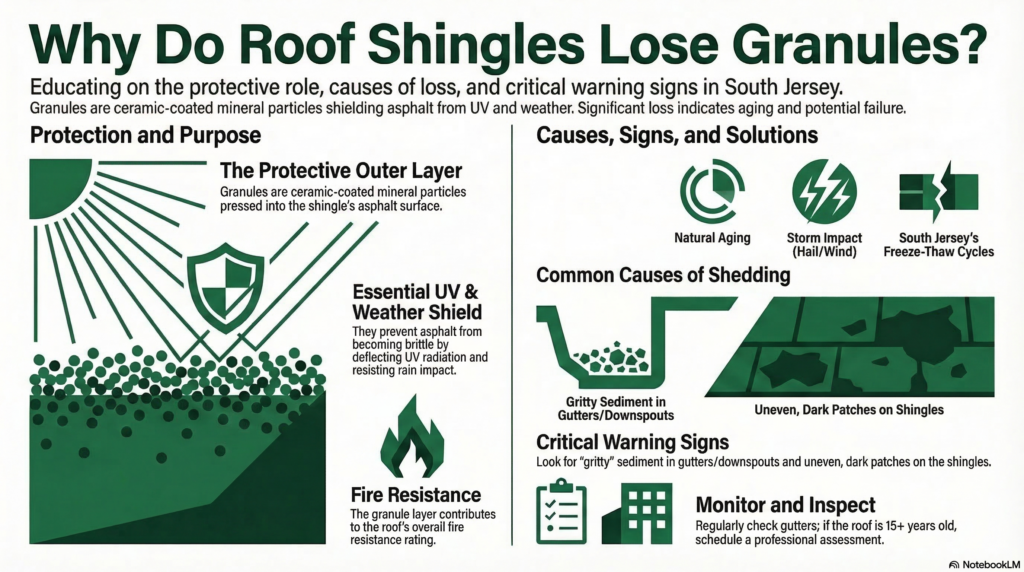
Asphalt shingles are built in layers. The core is a fiberglass or organic mat. Over that sits a layer of asphalt, which provides waterproofing. On top of the asphalt is the granule layer — ceramic-coated mineral particles pressed into the surface during manufacturing.
Granules serve three primary functions:
UV protection. Direct sunlight breaks down asphalt over time. Granules act as a barrier, absorbing and deflecting UV radiation before it reaches the asphalt beneath. Without adequate granule coverage, asphalt becomes brittle, cracks, and loses its waterproofing properties much faster.
Weather resistance. Granules add physical durability to the shingle surface, providing resistance against rain impact, debris, and hail.
Fire resistance. The granule layer contributes to the fire resistance rating of the shingle system.
When granule coverage becomes significantly depleted, the asphalt beneath is exposed. The shingle’s ability to protect your home diminishes, and its remaining serviceable life shortens.
Why Shingles Lose Granules: The Primary Causes
Cause 1: Normal Aging
This is the most common cause — and the most expected.
Granules are bonded to the asphalt surface during manufacturing, but that bond weakens over time. As a shingle ages through years of weather exposure, thermal cycling, and UV stress, the asphalt beneath the granules gradually hardens and becomes less effective at holding them in place. Granules begin to loosen and shed, slowly at first and then at an accelerating rate as the shingle approaches the end of its useful life.
On a standard architectural shingle with an expected lifespan of 20–25 years, moderate granule loss in the later years is expected. It is one of the signs that a roof is maturing. The question is always how much loss, how widespread, and whether the shingle still has adequate coverage to do its job.
In many South Jersey homes built in the 1980s and 1990s, roofs are now well into the range where age-related granule loss is a primary inspection finding.
Cause 2: Weather Exposure and Storm Impact
South Jersey’s climate creates specific stressors that accelerate granule loss beyond normal aging.
High winds loosen granules at the leading edges of shingles and in areas where shingles have even minor lifting. Wind-driven debris — small branches, grit, and particulates — acts as an abrasive against shingle surfaces over years of exposure.
Heavy rain and hail physically dislodge granules through direct impact. A single significant hail event can cause measurable granule loss across a roof, even when the damage is not visible from the ground as obvious impact marks.
Nor’easters, which affect South Jersey with regularity, combine wind, rain, and sometimes ice in sustained multi-hour events. These storms are consistently among the top causes of accelerated granule shedding on homes in Burlington, Camden, and Gloucester Counties.
Freeze-thaw cycles in winter stress the shingle surface repeatedly. Water works into microscopic gaps at the granule-asphalt interface, freezes, expands, and dislodges granules in a slow but cumulative process across multiple winter seasons.
Cause 3: New Shingle Shedding
This is worth understanding because it can cause unnecessary concern.
When new shingles are installed, there is always some excess granule material on the surface — granules that were not fully bonded during manufacturing, or that loosened during handling, cutting, and installation. In the first few weeks to months after installation, these loose granules shed and appear in the gutters.
This is normal and does not indicate a problem with the shingles. It typically slows substantially within the first season.
The distinction matters: granules in the gutters on a recently replaced roof are usually residual manufacturing surplus. Granules in the gutters on a roof that is 15, 20, or 25 years old are a different signal — they indicate the bonding on aging shingles is failing.
Cause 4: Physical Damage and Foot Traffic
Shingles are not designed to be walked on regularly. Each step on a shingle surface dislodges granules at the contact points. A single careful inspection walkthrough causes minimal impact. Repeated foot traffic — from multiple service visits, DIY maintenance, or improperly conducted inspections over the years — accumulates into visible granule loss along the paths taken.
This type of damage appears as streaks or worn paths across sections of the roof rather than the broader, uniform thinning associated with aging.
Similarly, low-hanging tree branches that contact the roof surface during wind act as a slow abrasive, scraping granules from the shingles they brush against. In the tree-lined neighborhoods common throughout South Jersey, this is a consistent contributing factor on older roofs.
Cause 5: Manufacturing Defects or Poor-Quality Materials
Less common than the above causes, but worth noting: not all shingles are manufactured equally. Some products — particularly lower-cost options — have bonding that degrades faster than the manufacturer’s rated lifespan would suggest. When granule loss is concentrated on a roof that is only 8–12 years old with no obvious physical cause, material quality or a manufacturing issue may be a factor.
If a roof was replaced with a lower-cost product during a previous re-roof, accelerated granule loss is a finding that warrants documentation and, in some cases, contact with the manufacturer if the product is still within its warranty period.
Where to Look for Signs of Granule Loss
Granule loss is visible in several places — not all of them on the roof itself.
In the gutters. This is often the first and most noticeable sign. Significant granule buildup — particularly after rain — indicates active shedding. The volume and consistency of buildup in the gutters is a useful indicator of how actively shingles are losing material.
At downspout outlets. Granules flush through the gutters and collect at or around downspout discharge points. Heavy accumulation here after storms points to active loss.
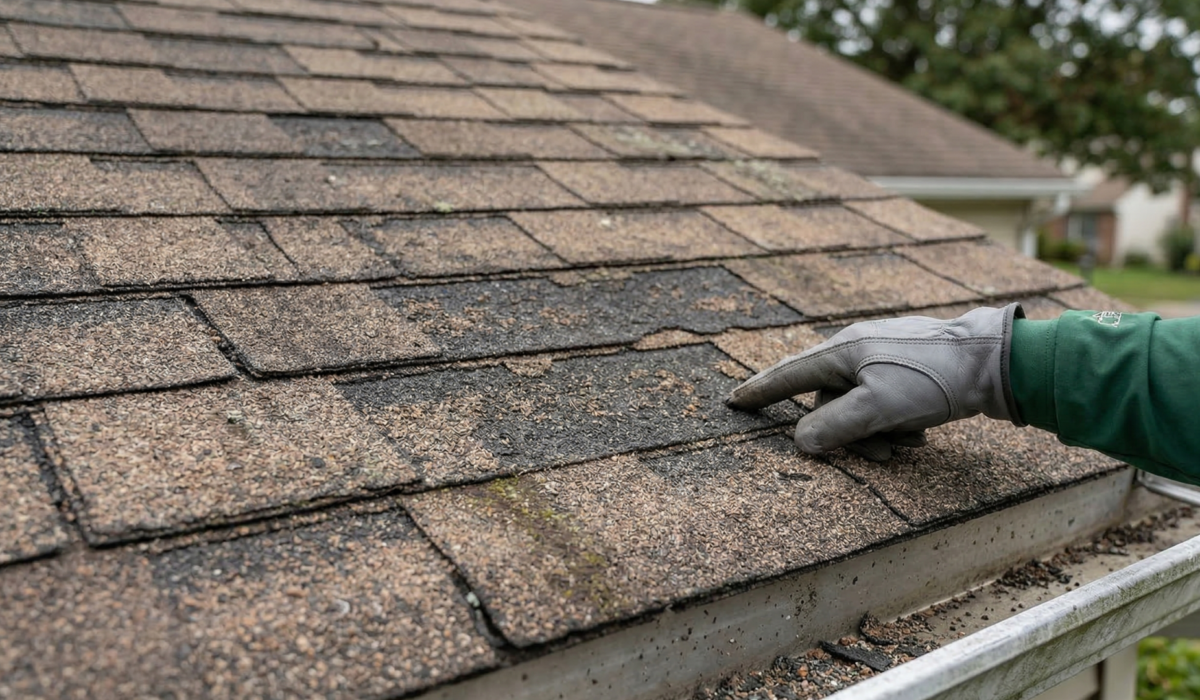
On the shingle surface itself. As granule coverage thins, the darker asphalt layer beneath becomes visible. This shows as darker or bare-looking patches, often most visible in raking light or when the roof is wet. On older roofs, this may be visible from the yard with a close look.
Along valleys and at low points. Granules shed from upper portions of the roof collect in valleys and at the lower course of shingles. Heavy accumulation in these areas indicates loss from above.
What Granule Loss Means for Your Roof’s Remaining Life
The significance of granule loss depends heavily on the pattern and extent of what’s happening.
Light, uniform thinning on a roof approaching the end of its lifespan is expected and signals that the roof is maturing normally. It is a sign to monitor and schedule an evaluation — not an immediate emergency.
Widespread bare patches or significant asphalt exposure on a roof that is 15 years or older indicates the shingles are failing. Once asphalt is consistently exposed, deterioration accelerates. Water begins to penetrate more easily, and the remaining time before leaks become likely compresses.
Concentrated loss after a storm — particularly hail — may indicate impact damage that warrants documentation regardless of the roof’s age, as this is often relevant to an insurance evaluation.
Localized loss on a newer roof is worth investigating for physical causes — foot traffic, tree contact, or material quality — before drawing conclusions.
Does Granule Loss Mean the Roof Needs to Be Replaced?
Not automatically. Extent and context determine the right response.
A professional inspection may find that repair is appropriate when:
- Granule loss is limited to specific sections while the majority of the roof remains sound
- The roof is within its expected lifespan and loss is not yet widespread
- The cause is physical and addressable — such as overhanging branches that can be trimmed
Replacement is typically the more practical answer when:
- Granule loss is widespread across the full roof surface
- The roof is at or beyond its expected lifespan
- Asphalt exposure is visible across multiple sections
- Other conditions — curling, flashing failures, attic moisture — are present alongside significant granule loss
Granule loss is most useful as one data point in a full inspection picture, not as an isolated indicator read in isolation.
Understanding_Shingle_Granule_Loss
Download this PDF – Understanding Shingle Granule Loss
Frequently Asked Questions
Is it normal to find shingle granules in gutters? Some granules in gutters are normal, particularly on newer roofs shedding manufacturing surplus or after significant storms. Consistent, heavy accumulation on a roof 15 years or older is a sign worth having evaluated.
How quickly does a roof fail after granule loss begins? There is no fixed timeline — it depends on how much coverage remains, the roof’s age, and ongoing weather exposure. A professional inspection gives you a realistic picture based on actual conditions.
Can granule loss be repaired? There is no reliable method to restore granule coverage to depleted shingles. Repair typically means replacing affected sections rather than treating the existing shingle surface.
Does hail always cause visible granule loss? Hail impact can displace granules without leaving obvious dents or cracks visible from the ground. A professional post-storm inspection documents what is actually present at the shingle surface.
How do I know if granule loss is from aging or storm damage? Pattern and distribution are key. Age-related loss tends to be gradual and widespread. Storm-related loss often appears in concentrated patterns that correspond to the direction and intensity of the event. A professional inspector can distinguish between the two.
What to Do If You’re Seeing Granules in Your Gutters
Finding granules during gutter cleaning, or noticing buildup at your downspouts after rain, is a reasonable prompt to schedule a professional roof inspection — particularly if your South Jersey home’s roof is 15 years or older.
An inspection will tell you whether what you’re seeing is within normal range, whether it indicates a roof that is approaching the end of its serviceable life, or whether it points to a specific issue worth addressing now.
T.A. Hughes III Roofing offers free, no-obligation roof inspections for homeowners throughout Burlington, Camden, and Gloucester Counties.
[Schedule a free inspection to get a clear, honest assessment of your roof’s condition. →]
T.A. Hughes III Roofing is a family-owned exterior remodeling contractor serving South Jersey for over 45 years. The company is fully licensed and insured in the State of New Jersey and holds GAF Certified Roofing Contractor status.