
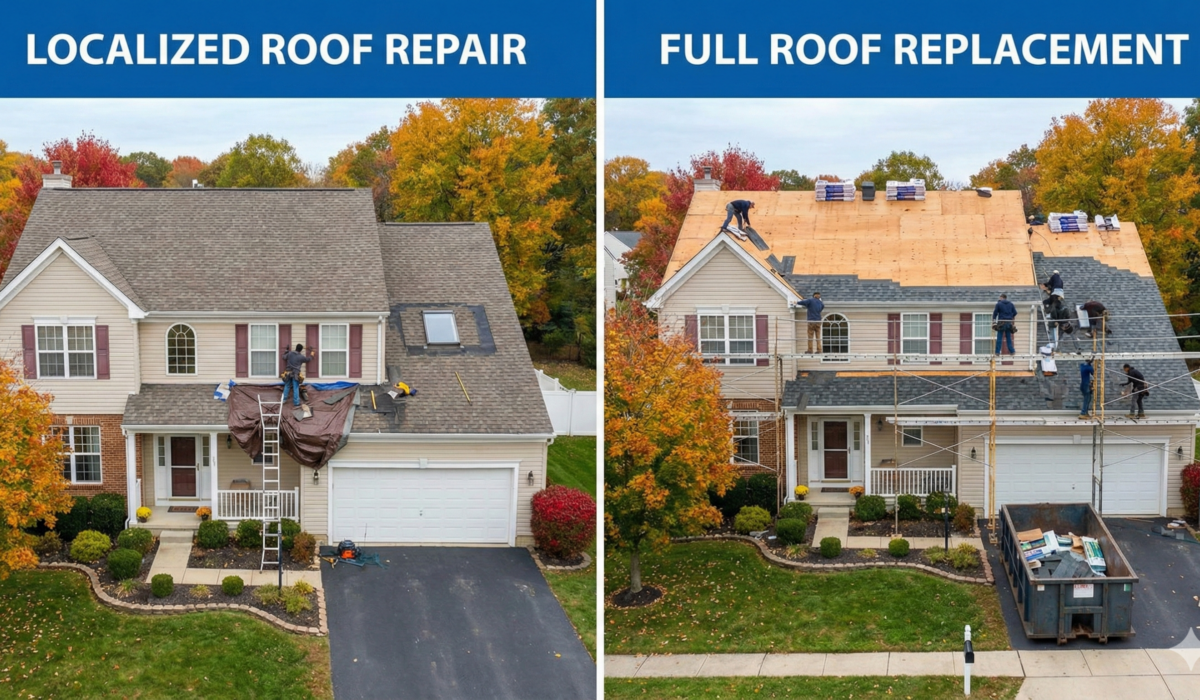
Practical guidance for New Jersey homeowners — especially those with roofs 10+ years old.
Choosing between a roof repair and a full replacement can significantly impact your budget and the lifespan of your home’s most important protective system. While replacements are necessary in many cases, there are many situations where a repair is the smarter choice — saving you money and extending your roof’s service life without compromising your home’s integrity.
This guide walks you through the most common, real‑world signs that a repair — not a replacement — is the right call.
Further reading: How Long Should a Roof Last in New Jersey?
Why Choosing the Right Option Matters
Roof replacements in New Jersey can cost thousands of dollars. If your roof is relatively healthy, a targeted repair can postpone a replacement and keep your home protected. This is especially true for homeowners with roofs around 10–20 years old — an age range where isolated issues, rather than total failure, are common.
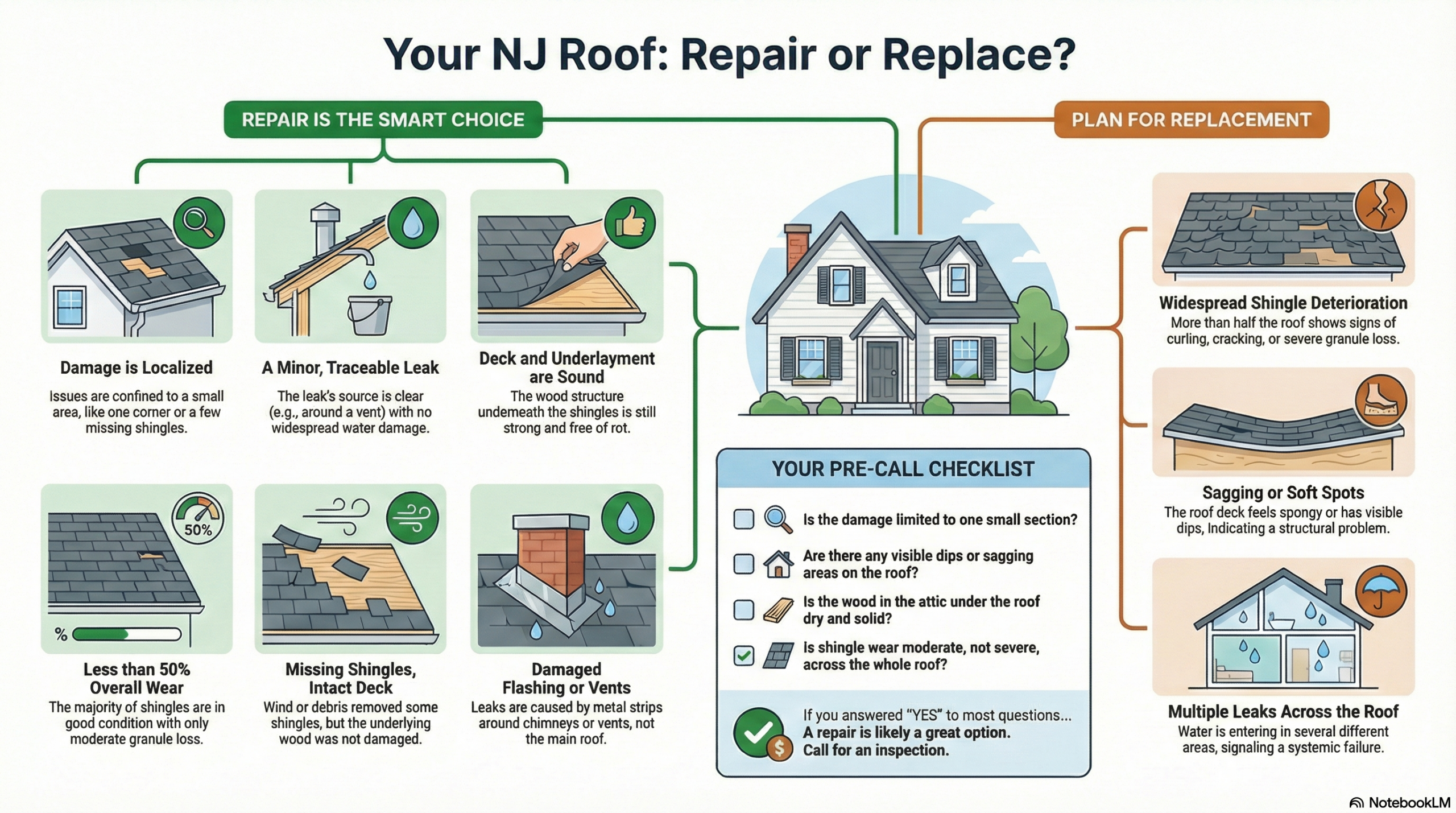
Sign #1: Damage Is Localized to a Small Area
If the issue is limited to one section of your roof — such as one corner, valley, or a handful of shingles — repairs may be all you need.
Common examples:
-
A small patch missing shingles from a recent wind gust
-
Minor roof flashing problems around a skylight or vent
Why this matters:
Localized damage without structural deterioration rarely requires a full replacement.
Sign #2: Minor Leaks With Clear Causes
A repair is appropriate if:
-
A leak is traced to a specific spot (flashing, pipe boot, valley)
-
No widespread signs of water damage are present in the attic or ceiling
What to check for:
-
Water stains in attic sheathing
-
Drip patterns around roof penetrations
If the leak is traceable and isolated, a skilled roofing contractor can fix the source without replacing the whole roof.
Further reading: Do You Need a Permit for Roof Work in Burlington County?
Sign #3: Roof Deck and Underlayment Are Still Sound
The condition of your:
-
Roof deck (the wood underneath)
-
Underlayment (protective membrane under shingles)
matters more than the age of the shingles alone.
Good news:
If these structural layers are in excellent condition, repairing shingles and flashing usually restores performance.
Sign #4: The Roof Is Showing Less Than 50% Wear
Not all aged roofs need replacement. If your roof still has:
-
The majority of its original shingles
-
Only moderate granule loss
-
Minimal curling or cracking
then a repair can extend its life.
Rule of thumb:
If wear is under 40–50%, repairs can be a cost‑effective bridge to a future replacement.
👉 Further reading Signs of a Failing Roof for NJ Homeowners
Sign #5: Missing Shingles But No Deck Damage
Wind or falling limbs sometimes strip shingles. If:
-
The underlying roof deck is intact
-
There’s no bracing failure or sagging
Then replacing the missing shingles and sealing the area is often sufficient.
Sign #6: Flashing or Vent Damage
Flashing problems around chimneys, vents, or skylights are a frequent cause of leaks. These are often repairable without a full roof replacement.
Fixing flashing can stop leaks and prolong overall roof life — especially if the rest of the roof is structurally sound.
Sign #7: Installed Recently With a Valid Warranty
If your roof is still within a valid warranty period:
-
Manufacturer warranty (materials)
-
Contractor workmanship warranty
and the issue falls under those terms, a repair (covered by warranty) is often the most cost‑effective path.
When a Replacement Is Likely the Better Choice
There are times when repairs won’t cut it:
| Roof Repair (Localized) | Full Roof Replacement | |
|---|---|---|
| Cost Range | A fraction of replacement cost [1] | Thousands of dollars (financing up to $100,000 available) [1, 4] |
| Lifespan Added | Several years [1] | Full expected life of the product system (25 years to “lifetime”) [2] |
| Typical Scenarios | Localized damage, wind gusts, minor leaks from flashing or vents [1] | Multiple leaks, sagging, widespread wear, or structural damage [1] |
| Warranties Affected | Usually does not void warranties if properly documented [1] | Includes Manufacturer and Contractor warranties [2] |
| Permitting Needs | Often required to meet NJ safety standards [2] | Mandatory in NJ to ensure inspections and compliance [2] |
| Risk of Doing Too Late | Small issues become major repairs (leaks, rot, interior damage) [3, 4] | Major failure, insurance denials, costly structural damage [2, 3] |
| Best Contractor Question | Is the leak traceable and is the roof deck sound? [1] | Is labor included in the warranty and who registers it? [2] |
| Why This Matters | Repairs buy time affordably while preserving structure [1] | Full replacement solves systemic issues and protects value [1] |
[1] When to Choose Roof Repair Over Replacement
[2] The Homeowner’s Guide to Roof Warranties and Coverage Protection
[3] Seasonal Guide to New Jersey Roof Inspections
[4] T.A. Hughes III Roofing | Quality Never Goes Out of Style
If more than one area is deteriorating, replacement may be safer and more cost‑effective long term.
Click Here to download the PDF Below – Repair Or Replace, The Homeowner Roof Guide
Repair_or_Replace_The_Homeowner_Roof_Guide
Roof Repair vs Replacement Checklist
Ask yourself:
✔ Is the damage limited to a small section?
✔ Is the underlayment and roof deck still sound?
✔ Is granule loss moderate (not severe)?
✔ Do I have a valid warranty on materials or installation?
✔ Is there no structural sag or rot?
If most answers are “yes,” a repair is likely.
Can a roof still be repaired if it’s 15 years old?
Yes. If wear is localized and the deck is sound, a roof in this age range often benefits from repairs rather than full replacement.
Is it cheaper to repair than replace?
Generally yes — repairs target specific problems and cost a fraction of a full replacement.
Will repairing a roof extend its lifespan?
Yes. Timely repairs can extend the life of a roof by several years, especially if combined with regular inspections.
Do roof repairs affect my warranty?
If done by a certified contractor and documented, repairs usually don’t void warranties. Always verify terms.
When should I call a professional?
Call a roofing professional at the first sign of water stains or missing shingles — early diagnosis leads to more repair options.
Roof Deck: The wood beneath your shingles that provides structural support.
Underlayment: Waterproof layer between shingles and deck that protects from moisture.
Flashing: Thin metal installed around roof penetrations (vents, chimneys) to prevent leaks.
Granule Loss: Wearing away of the protective granules on shingles — a sign of aging.
Sagging: A visible dip in the roof surface indicating structural issues.
Conclusion: Repair When You Can, Replace When You Must
A roof is one of your home’s most crucial defenses. When its problems are isolated and inspectable, repairs are a smart, economical choice — especially if you’re in the 10–20 year age range. But if damage is widespread or structural, replacement becomes necessary.
Schedule a professional inspection — it’s the best way to know what’s truly needed and avoid costly missteps.