
What Parts of a Roof Fail First?
The parts of a roof that fail first are almost never the shingles themselves. Flashing at penetrations and transitions, sealants around vents and chimneys, pipe boots, and ridge components typically show wear and failure well before the main shingle field deteriorates. In South Jersey, where seasonal storms and temperature swings put consistent stress on roofing systems, these smaller components are responsible for the majority of leaks on roofs that still have years of shingle life remaining.
Key Takeaways
- Flashing, sealants, pipe boots, and ridge components typically fail before the shingle field
- Most leaks on aging roofs in South Jersey originate at transitions and penetrations, not in the middle of the shingle surface
- A roof can have sound shingles and still be leaking — the failure is usually at a detail component
- Understanding which components wear fastest helps homeowners know what to ask about during an inspection
- Proactive attention to failing components can extend the overall life of a roofing system before full replacement is warranted
When homeowners think about a roof failing, they usually picture shingles — missing, cracked, or visibly deteriorated. And shingle condition matters. But in practice, the components that give out first on an aging roof are typically the smaller, less visible details: the metal work, the sealants, the boots, the transitions.
Understanding which parts wear fastest — and why — gives homeowners a more accurate picture of what they’re actually managing as a roof ages.
How a Roof Ages: Not All at Once
A roofing system is made up of multiple components, each with its own material composition, exposure level, and expected lifespan. They don’t all age at the same rate.
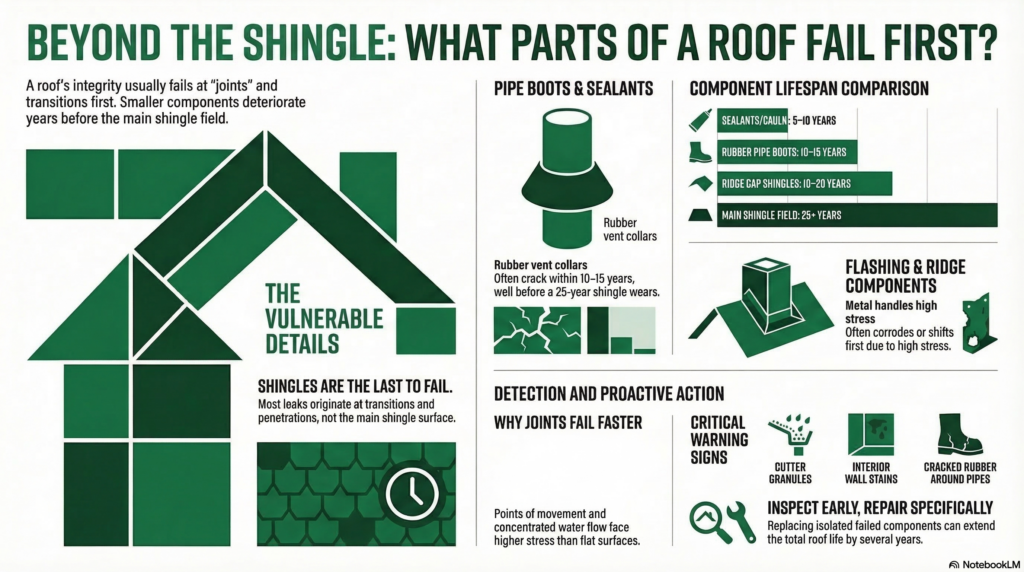
The broad shingle field — the expanse of shingles covering most of the roof — is the most visible part and often the last to fail under normal conditions. The components that handle transitions, penetrations, and movement are working harder and aging faster.
This is why a professional roof inspection evaluates the entire system, not just shingle appearance. A roof that looks fine from the driveway can have active water entry at a failed flashing or a cracked pipe boot that has nothing to do with shingle condition.
The Parts That Fail First — and Why
Pipe Boots and Penetration Seals
Pipe boots are the rubber or metal collars that seal around plumbing vent pipes where they exit through the roof. They are among the most consistently failed components found on aging roofs throughout South Jersey — and one of the most overlooked.
The rubber used in standard pipe boots has a lifespan significantly shorter than most shingle systems. On a 20-to-25-year roof, the rubber collar around plumbing vents is frequently cracked, split, or completely deteriorated well before the surrounding shingles show significant wear. Once the rubber fails, there is an open gap around the pipe — and water enters during rain events.
What makes pipe boot failure particularly problematic is that the leak path is rarely direct. Water that enters around a pipe boot often travels down the pipe or along the decking before appearing inside the home — sometimes several feet from the actual entry point. This makes the source difficult to identify without a thorough inspection.
On many South Jersey homes from the 1980s and 1990s, original pipe boots have never been replaced. They are a high-priority inspection item on any roof of meaningful age.
Step Flashing Along Walls and Dormers
Step flashing is the series of small metal pieces that create a waterproof transition where a roof surface meets a vertical wall — at dormers, additions, garage walls, or anywhere a roof abuts a structure above it.
Properly installed step flashing works in layers with the siding above it to shed water down and away. Over time, several things cause it to fail:
- Siding above the flashing deteriorates and allows water behind it, which then finds its way past the flashing
- Individual pieces of step flashing shift, pull away, or corrode
- Sealants applied over improperly installed step flashing — a common shortcut — dry out and crack, removing the only thing that was preventing water entry
Step flashing failures are a frequent source of wall leaks, which often appear as staining on interior walls or ceilings near dormers or additions rather than at an obvious roof location. On homes with additions built in the 1980s and 1990s, the step flashing at the addition roofline is a particularly common inspection finding.
Chimney Flashing
Chimney flashing is among the most complex and highest-risk details on a residential roof. A chimney penetrates the roof at multiple angles and requires several interlocking flashing components — base flashing, step flashing, counter flashing, and in many cases a saddle or cricket on the high side to divert water around the structure.
Any one of these components can fail independently. The most common failure points are:
Dried or cracked sealant at the counter flashing. Many chimneys rely partly on sealant to bridge the gap between the counter flashing embedded in the masonry and the base flashing on the roof. That sealant has a limited lifespan and dries out reliably in South Jersey’s climate.
Mortar joint deterioration. Counter flashing is often set into a cut reglet in the chimney mortar. As mortar weathers, that joint opens, and the flashing loses its seal.
Rust and corrosion on older metal flashing. Galvanized steel flashing from the 1980s and 1990s has typically exhausted its corrosion resistance by now, developing pinhole rust through which water enters slowly.
Chimney-related leaks are among the most commonly misdiagnosed roofing problems. Because water can travel a significant distance from the entry point before appearing inside, homeowners and even less experienced contractors sometimes mistake a chimney flashing failure for a shingle problem in a different area of the roof.
Ridge Cap Shingles
The ridge — the peak where two roof planes meet — is covered with ridge cap shingles that are bent to straddle the apex. This position exposes them to maximum wind stress from both directions and direct weather exposure from above.
Ridge caps typically show wear before the field shingles below them. On older roofs, it is common to find:
- Cracked or split ridge caps that have lost flexibility with age
- Lifted corners from wind stress, creating gaps
- Missing ridge caps in sections where wind has dislodged them entirely
Beyond the caps themselves, the ridge is also where ridge vent systems are installed on homes with proper attic ventilation. Where ridge vent material or baffles have degraded, wind-driven rain and debris can enter the vent opening — an issue that doesn’t show up as a visible shingle problem but can introduce moisture into the attic.
Valley Flashing
Roof valleys — where two sloping planes meet and channel water downward — handle a concentrated volume of water during every rain event. This concentrated flow accelerates wear on whatever material lines the valley.
Open metal valleys use sheet metal to line the channel. Closed-cut or woven valleys use shingles. Both are vulnerable to specific failure modes as they age.
Metal valley flashing can develop rust or corrosion over time, particularly where debris accumulates and holds moisture against the surface. Asphalt valley shingles in closed or woven configurations wear faster at the center of the valley where water flow is heaviest, developing granule loss and thin spots before the surrounding shingle field shows comparable wear.
Valley failures typically produce leaks that appear on the ceiling or wall below the valley — which on many South Jersey colonial and split-level homes means staining that appears inside the home well away from an exterior wall.
Sealants at Vents, Skylights, and Roof Accessories
Every piece of roofing hardware that penetrates or terminates at the roof surface — exhaust vents, attic fans, solar penetrations, satellite dish mounts — was sealed at installation with roofing caulk or butyl tape. These sealants do not last as long as the shingles around them.
Standard roofing sealants begin to dry, shrink, and crack within 5 to 10 years under South Jersey’s weather conditions. On roofs that are 20 years or older, original sealants at these locations are almost universally compromised. The penetration may still look intact from a distance while harboring an active gap at the seal that allows water entry during rain.
This is one of the most straightforward proactive maintenance items on an aging roof — replacing dried sealants before gaps develop — and one of the most commonly overlooked.
Drip Edge at Eaves and Rakes
Drip edge is the metal strip installed at the roof’s lower edges — the eaves and rakes — that directs water away from the fascia and into the gutters. On many South Jersey homes from the 1980s and 1990s, drip edge was installed in thinner gauges than modern standards, or in some cases was omitted at the rake edges entirely.
Over time, drip edge at the eaves corrodes or pulls away from the fascia. Where gutters are attached directly over deteriorated drip edge, water bypasses the gutter and runs behind it against the fascia board. Fascia rot — a consistent finding on older South Jersey homes — often originates here.
Soffit and Fascia as Indicators
While not part of the waterproofing system itself, soffit and fascia condition often signals what is happening at the roof edges. Rotting fascia, peeling soffit panels, and staining at the eaves are frequently the visible result of drip edge failure, gutter overflow, or ice damming — all of which trace back to roof system performance.
On a full inspection, fascia and soffit condition is evaluated because it tells part of the story about how water is or isn’t being managed at the roof’s perimeter.
Why Shingles Are Usually the Last to Fail
It is worth being direct about this: on the majority of aging roofs in South Jersey, the shingle field outlasts the detail components around it.
This happens for a simple reason. Shingles are a large, uniform surface designed for primary weather exposure. The components around penetrations, transitions, and edges are working at joints — points of movement, material change, and concentrated stress. Joints fail before flat surfaces in almost every building system.
This means a roof inspection that only evaluates shingle condition is incomplete. The leaks on most aging roofs are at the details, not the field. A thorough inspection looks at all of it.
What This Means for Repair vs. Replacement
Understanding which components fail first has a practical implication for decision-making.
When a component failure is isolated — a single failed pipe boot, deteriorated chimney sealant, or a section of compromised step flashing — and the shingle field is otherwise sound, targeted repair is often the right and cost-effective answer. Replacing the failed component extends the usable life of the existing roof without the cost of full replacement.
When multiple detail components are failing simultaneously, or when component failures are occurring alongside widespread shingle deterioration, it often indicates the system as a whole has reached the end of its serviceable life. At that point, repairing individual components becomes less cost-effective than addressing the full system.
The distinction requires an accurate inspection — not assumptions in either direction.
Roof_Failure_Field_GuideDownload Roof Failure Field Guide
Frequently Asked Questions
What is the most common source of roof leaks on older homes? Flashing failures — particularly at chimneys, pipe boots, and wall transitions — are the most frequent source of leaks on aging roofs in South Jersey, often on roofs whose shingles still appear relatively sound.
How long do pipe boots last compared to shingles? Standard rubber pipe boots typically last 10–15 years. A 20-to-25-year roof has almost certainly outlasted its original pipe boots, making them a high-priority inspection and replacement item.
Can a roof leak without any missing or visibly damaged shingles? Yes — and this is common. Most leaks on roofs in good general condition originate at detail components like flashing, pipe boots, and sealants that fail without any visible shingle damage above them.
How do I know if flashing needs repair or the whole roof needs replacement? A professional inspection evaluates both the detail components and the overall shingle condition. When only the details are failing and the field is sound, repair is often appropriate. When failures are widespread across the system, replacement is the more practical answer.
Is chimney flashing repair difficult? Proper chimney flashing repair requires careful attention to how the layers interact. It is not a one-step sealant application — it involves evaluating the full flashing assembly and addressing the actual source of failure rather than applying a surface patch over a structural gap.
What to Do With This Information
If your South Jersey home’s roof is 15 years or older, the most useful step is a professional inspection that evaluates the full system — shingles, flashing, pipe boots, ridge, valleys, sealants, and drainage. Knowing exactly which components are performing and which are not gives you an accurate, specific picture of what your roof actually needs.
T.A. Hughes III Roofing offers free, no-obligation roof inspections for homeowners throughout Burlington, Camden, and Gloucester Counties.
Schedule a free inspection to get a clear, honest picture of your roof’s condition.
T.A. Hughes III Roofing is a family-owned exterior remodeling contractor serving South Jersey for over 45 years. The company is fully licensed and insured in the State of New Jersey and holds GAF Certified Roofing Contractor status.