
What Are the Most Common Exterior Problems on Older South Jersey Homes?
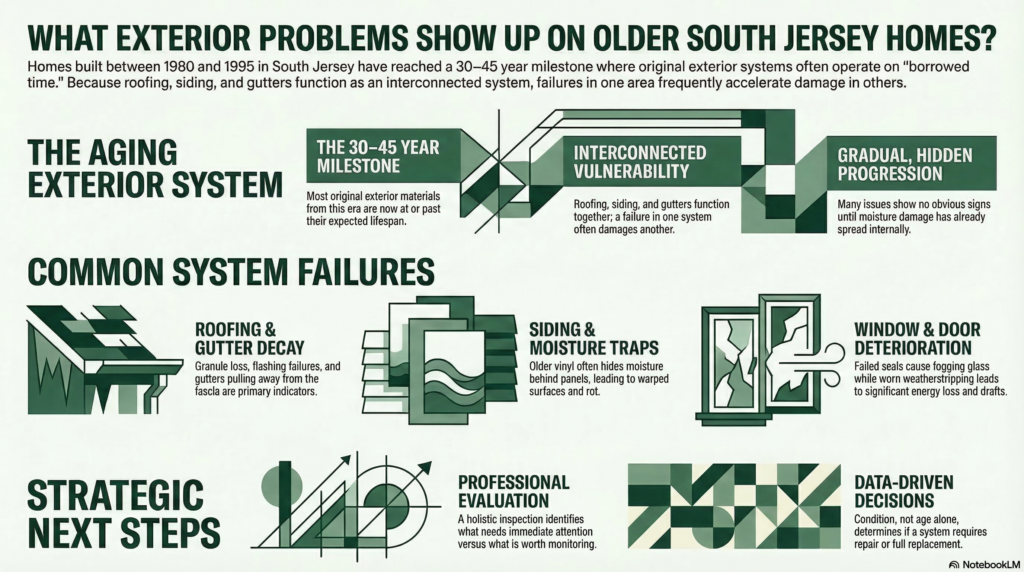
The most common exterior problems found on 1980s–1990s homes in South Jersey include aging roofing systems with granule loss and flashing failures, siding with moisture damage or warping, windows and doors with failed seals and drafts, and gutters that no longer manage water properly. These issues rarely appear in isolation — they develop gradually and often affect connected systems.
Key Takeaways
- Homes built in the 1980s and 1990s in South Jersey are now 30–45 years old — many exterior systems are at or past their expected lifespan
- Roofing, siding, windows, doors, and gutters function as a connected system — a problem in one area often affects the others
- Many issues develop gradually and show no obvious signs until damage has already spread
- Not every finding requires full replacement — condition determines the right approach
- A professional inspection is the most reliable way to know what you’re actually dealing with
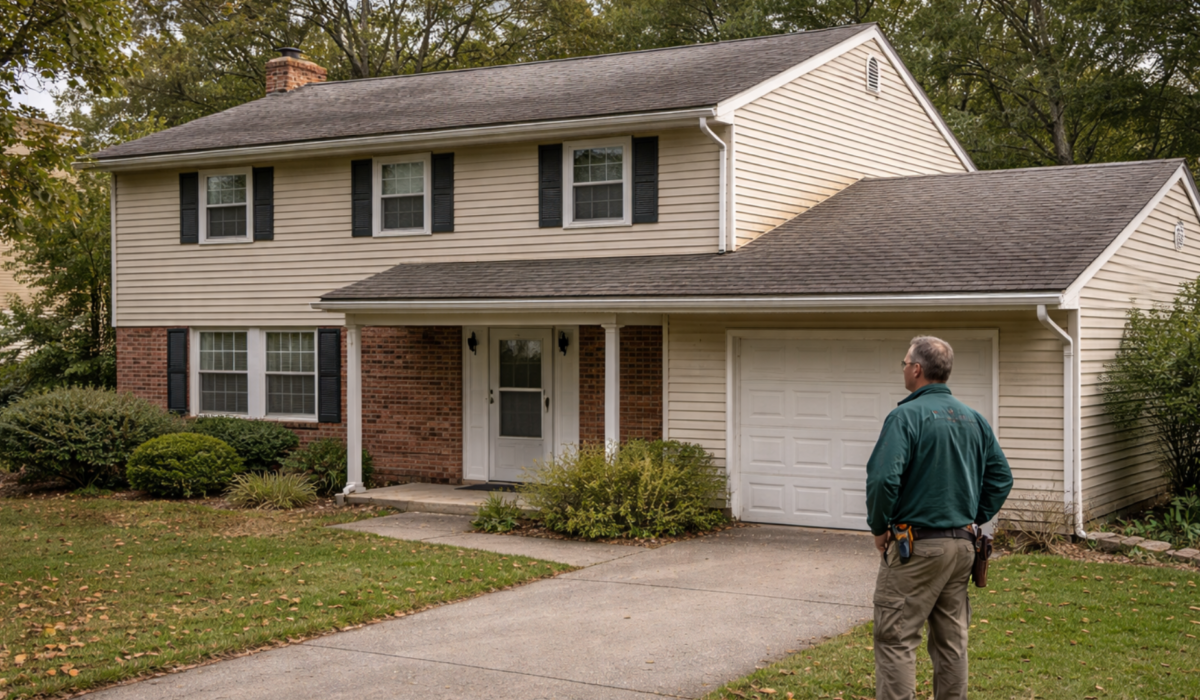
If your South Jersey home was built between 1980 and 1995, it is now between 30 and 45 years old. That’s a meaningful milestone for exterior systems.
The roofing, siding, windows, doors, and gutters installed during that era were built to last — but not forever. In Burlington, Camden, and Gloucester Counties, decades of wind, rain, heat, humidity, and seasonal storms leave a predictable set of marks on homes from this period.
This guide covers what contractors most commonly find on homes from this era, why these issues develop, and what they actually mean for the homeowner.
Why Homes From This Era Are Worth a Closer Look
Most of the residential neighborhoods in South Jersey were developed heavily during the 1970s, 1980s, and 1990s. The homes are well-built — split-levels, colonials, and ranches that have held up for decades. But at 30 to 45 years of age, original exterior materials are operating on borrowed time in many cases.
Here is what makes this era of home particularly relevant:
- Original roofing systems from this period — even quality ones — carry expected lifespans of 20–25 years for standard architectural shingles. Many have already been replaced once. Some have not.
- Vinyl and aluminum siding installed in the 1980s and early 1990s has reached an age where cracking, fading, and moisture intrusion become increasingly common.
- Original windows and doors from this era commonly used single-pane glass or early double-pane systems. Seal failures and frame deterioration are expected at this age.
- Gutter systems installed with the original home have experienced decades of clogging, freeze-thaw cycles, and shifting — often without proper maintenance.
None of this means your home is in poor condition. It means certain systems deserve a professional look.
What Exterior Problems Are Most Common on 1980s–1990s South Jersey Homes?
Here is what contractors most frequently find when inspecting homes from this period in Burlington, Camden, and Gloucester Counties.
Roofing: What Shows Up Most Often
Granule Loss on Aging Shingles
Asphalt shingles protect themselves with a layer of granules — the rough, sand-like coating on the surface. Over time, those granules loosen and shed. When granule loss becomes significant, the asphalt beneath is exposed directly to UV rays and weather, which accelerates deterioration.
On homes from this era, granule loss is often visible in the gutters before it’s obvious on the roof itself. It’s one of the clearest indicators that a roofing system is nearing the end of its serviceable life.
Flashing Failures Around Chimneys and Vents
Flashing — the metal material that seals the joints between your roof and vertical surfaces like chimneys, vents, and skylights — is frequently the source of leaks on older homes. Sealants dry out over time. Metal expands and contracts with temperature changes. Gaps develop gradually, and water finds its way in slowly, often without obvious interior signs at first.
Flashing failures are one of the most common findings on South Jersey homes from this period. In many cases, they are repairable without requiring full roof replacement.
Inadequate or Deteriorated Attic Ventilation
Ventilation systems installed in the 1980s and early 1990s frequently did not meet the standards that became common in later decades. Poor attic ventilation causes heat and moisture to build up, which accelerates shingle aging from below, increases the risk of ice dams in winter, and can create conditions for mold growth in the attic space.
This is one of the most overlooked issues on homes from this era — and one of the most consequential for long-term roof performance.
Shingle Curling and Cracking
As asphalt shingles age, they lose flexibility. Edges begin to curl upward or cup downward. Surfaces develop small cracks. On homes where the original roof has never been replaced, or where a replacement was done with lower-cost materials, these conditions are common findings.
Siding: What Shows Up Most Often
Moisture Trapped Behind the Panels
This is the most significant siding issue contractors find on homes from this period — and the least visible from the outside. Older vinyl siding was often installed without proper moisture barriers or with barriers that have since degraded. When moisture gets behind the panels and has nowhere to go, it works into the sheathing, trim, and framing over time.
By the time discoloration or soft spots become visible at the surface, the damage behind the panels is frequently more extensive than it appears.
Warping, Buckling, and Cracked Panels
Vinyl siding from the 1980s and early 1990s was thinner than modern products and more vulnerable to heat, impact, and age. In South Jersey’s climate — with hot summers and cold winters — repeated expansion and contraction leads to warping and buckling in older panels. Cracking becomes more common as the material loses flexibility with age.
Rot Around Trim, Windows, and Door Openings
Wood trim surrounding windows and doors is a consistently vulnerable area on homes from this era. When caulk and sealants around these openings dry out and crack — which happens reliably at 20–30 years — water finds entry points. The wood beneath absorbs moisture over repeated seasons, and rot follows. In many cases, this damage is not visible until trim is probed or removed during an inspection.
Fading and Color Degradation
Less structurally significant but worth noting: siding from this period has often faded considerably from its original color, and the color cannot be restored through painting on most vinyl products. While fading alone is not a performance issue, it is often the visible prompt that leads homeowners to have the system evaluated — and that’s when underlying issues are discovered.
Windows and Doors: What Shows Up Most Often
Failed Seals on Double-Pane Windows
Many South Jersey homes from the 1980s and 1990s were upgraded to double-pane windows at some point — either originally or in early renovation projects. The sealed air space between the panes provides insulation. When the seal fails, moisture enters that space and causes the characteristic fogging or clouding between the panes. Once a seal fails, it cannot be repaired. The glass unit or the full window requires replacement depending on the frame condition.
Drafts From Worn Weatherstripping and Seals
Original weatherstripping and door seals from this era are almost universally worn out. Drafts around doors and windows represent energy loss year-round and are particularly noticeable in winter. In many South Jersey homes, this is one of the most straightforward improvements available — and one that has a measurable impact on comfort and energy bills.
Difficulty Operating Windows and Doors
Frames shift over time. Hardware wears. Windows and doors that were once easy to operate become difficult to open, close, or lock. On older double-hung windows in particular, balance mechanisms fail and sashes no longer stay in position. These are not just convenience issues — windows and doors that don’t seal properly also create water intrusion risk during wind-driven rain.
Water Intrusion at Frame Edges
As exterior caulking around window and door frames dries out and cracks, water enters during heavy rain. In South Jersey, where wind-driven rain events are common, this is a consistent finding on homes from this period. Water intrusion at frames often appears first as staining on interior window sills or discoloration on nearby walls.
Gutters: What Shows Up Most Often
Gutters Pulling Away From the Fascia
Over decades of freeze-thaw cycles and debris weight, gutter hangers and spikes loosen. Sections begin to pull away from the fascia board, creating gaps where water overshoots the gutter entirely. On homes from this era, this is an extremely common finding — often in multiple sections simultaneously.
Improper Pitch and Standing Water
Gutters require a slight slope toward the downspout to drain properly. Over time, sections settle and shift. When gutters lose their pitch, water stands in the channel rather than draining, which accelerates corrosion and creates overflow conditions during heavy rain. In South Jersey’s climate, this is a consistent issue on gutters that have not been adjusted or replaced.
Undersized Systems
Gutter standards and sizing guidelines have evolved significantly since the 1980s. Many systems installed during that period are undersized relative to the roof area they serve — meaning they were working at or near capacity when new, and cannot manage the volume of water from larger storm events. This shows up as overflow along the full length of gutters, not just at clogged sections.
Foundation Water Exposure From Overflow
When gutters fail to move water away from the home effectively — whether from clogs, pitch problems, or undersizing — water pools near the foundation. In South Jersey, where many homes from this era have basements or crawlspaces, chronic water exposure at the foundation is a meaningful long-term concern.
How These Systems Affect Each Other
This is worth understanding clearly: exterior systems don’t fail independently. They are connected.
- A roofing failure that allows moisture into the attic creates conditions that affect structural sheathing
- Siding that traps moisture can migrate that moisture to window and door frames
- Gutters that overflow deposit water against siding and near foundation walls
- Flashing failures that go undetected allow water to travel inside wall cavities
This is why a professional evaluation of an older South Jersey home considers the full exterior picture, not just the single system that prompted the call.
Does This Mean Everything Needs to Be Replaced?
Not necessarily. Condition determines the right approach — not age alone.
In many cases on homes from this period, one or two systems have reached the end of their useful life while others remain serviceable. A realistic inspection identifies what actually needs attention now, what is worth monitoring, and what is still performing adequately.
Replacing systems that don’t yet need it doesn’t protect the home better. Accurate evaluation does.
South_Jersey_Exterior_Diagnostic_GuideDownload South Jersey Exterior Diagnostic Guide
Frequently Asked Questions
-
How do I know if my 1980s or 1990s South Jersey home needs a roof replacement?
- Age alone doesn’t tell the full story — a professional inspection evaluates shingle condition, flashing integrity, and attic conditions to give you an accurate picture.
-
Is it normal for siding to have moisture damage on a home this age?
- It’s common on homes from this era, particularly where original moisture barriers have degraded. The extent of damage varies and can only be assessed accurately through inspection.
-
Can windows from the 1980s and 1990s be repaired, or do they need replacement?
- Minor issues like hardware and weatherstripping can often be repaired. Failed seals between panes and deteriorated frames generally require replacement.
-
How often should gutters be replaced on an older home?
- Gutters don’t have a fixed lifespan, but systems from the 1980s and 1990s that show pulling, improper pitch, or frequent overflow are often past the point where repair is cost-effective.
-
Should I evaluate all exterior systems at once on an older home?
- It makes practical sense. Because these systems interact, a full exterior evaluation gives a clearer picture of priority, sequencing, and total scope — which helps with planning and budgeting.
What to Do Next
If your South Jersey home was built between 1980 and 1995, a full exterior inspection is a reasonable and low-commitment starting point. You’ll get an honest assessment of each system’s condition, documented findings, and clear guidance on what warrants attention — without pressure to act on anything.
T.A. Hughes III Roofing offers free, no-obligation exterior inspections for homeowners throughout Burlington, Camden, and Gloucester Counties.
Schedule a free inspection to get a clear, honest picture of your home’s exterior condition.
T.A. Hughes III Roofing is a family-owned exterior remodeling contractor serving South Jersey for over 45 years. The company is fully licensed and insured in the State of New Jersey and holds GAF Certified Roofing Contractor status.