What Causes Siding to Warp or Buckle?
Siding warps or buckles when it is exposed to excessive heat, trapped moisture, improper installation, or the natural stress of aging. In South Jersey, the combination of hot humid summers, seasonal storms, and homes with older siding systems makes warping and buckling one of the most common exterior issues contractors encounter. The cause determines whether repair or replacement is the right response.
Key Takeaways
- Warping and buckling are not always cosmetic — they often signal moisture problems developing behind the panels
- Heat exposure, trapped moisture, improper installation, and age are the four primary causes
- Vinyl siding expands and contracts with temperature — it must be installed with the correct spacing to allow for that movement
- Siding problems on homes from the 1980s and 1990s are particularly common in South Jersey due to material age and original installation standards
- An inspection is the only reliable way to determine whether the damage is surface-level or has spread behind the panels
Warped or buckled siding is one of those problems that homeowners often notice from the driveway but aren’t sure how seriously to take. It might look like a cosmetic issue. In some cases it is. In others, the visible distortion at the surface is a sign of something more significant happening behind the panels.
Understanding what actually causes siding to warp or buckle — and what it may indicate — helps homeowners make informed decisions rather than guessing.
Why Siding Warps and Buckles: The Four Primary Causes
Cause 1: Heat Exposure and Thermal Expansion
Vinyl siding expands when it heats up and contracts when it cools down. That’s expected and normal — the material is designed to handle it. The problem occurs when expansion has nowhere to go.
Vinyl siding is installed with small gaps at the ends of each panel and at trim connections specifically to allow for thermal movement. When those gaps are too tight — either because of improper installation or because the panels have been replaced without maintaining correct spacing — the siding has no room to expand during hot weather. It pushes against adjacent panels or fastening points and buckles outward.
In South Jersey, summers are consistently hot and humid. Homes with south- or west-facing siding are particularly exposed to direct afternoon sun, which can push surface temperatures on vinyl panels significantly above the ambient air temperature. On older homes, this is a common finding — especially where repairs or partial replacements were done over the years without attention to expansion spacing.
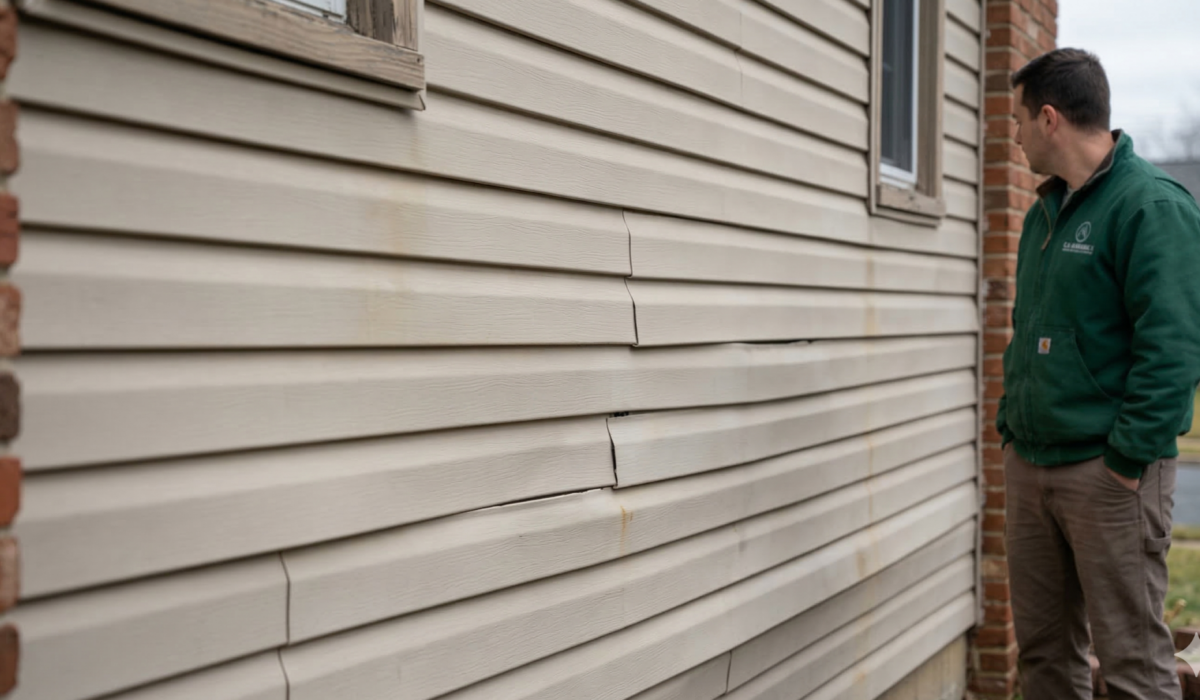
What this looks like: Wavy or rippled panels along horizontal runs, most visible in direct sunlight. The effect often appears and disappears with temperature changes, which leads some homeowners to dismiss it — but it signals an installation or material issue worth evaluating.
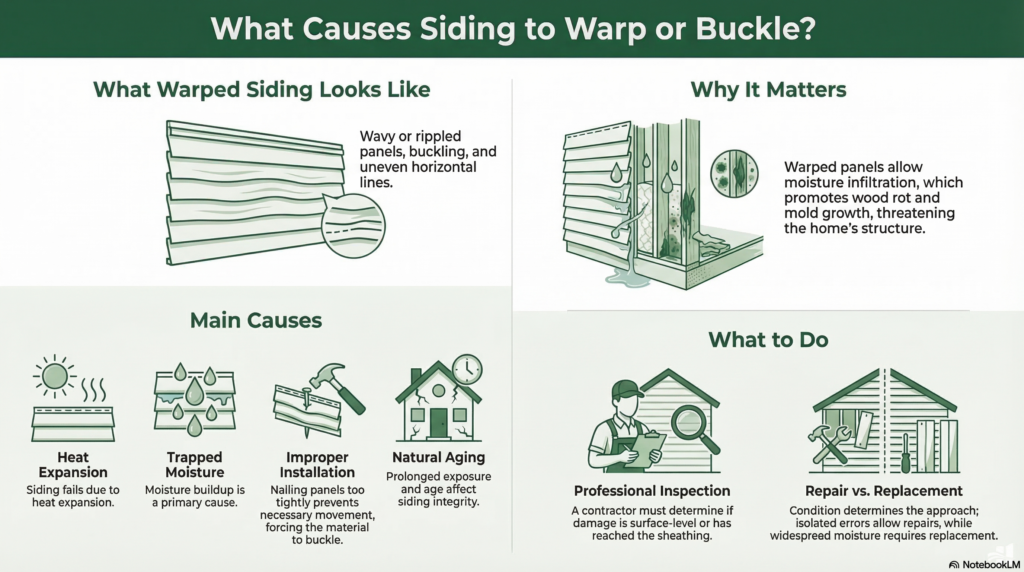
Cause 2: Moisture Trapped Behind the Panels
This is the most consequential cause of siding distortion — and the least visible from the outside.
Siding is designed to shed water, not to be completely waterproof. Properly installed siding systems include a moisture barrier behind the panels that allows any water that gets behind the siding to drain and dry rather than accumulate. When that moisture barrier is absent, degraded, or improperly installed, water that works its way behind the panels has nowhere to go.
Over time, trapped moisture:
- Saturates the sheathing beneath the siding
- Causes panels to swell, warp, and distort from behind
- Promotes rot in wood framing, trim, and structural components
- Creates conditions for mold and mildew growth inside the wall cavity
In many South Jersey homes from the 1980s and 1990s, original moisture barriers have degraded significantly or were installed to standards that are now considered inadequate. This is why moisture-related warping is a consistent finding on homes from this era.
What this looks like: Panels that appear pushed outward from behind, with distortion that doesn’t follow a regular thermal pattern. Soft spots when panels are pressed. Discoloration or staining at lower panel edges. Sometimes no visible warning at all — which is why inspection matters.
Cause 3: Improper Installation
Correct siding installation requires attention to details that aren’t visible once the job is complete. When those details are missed, the siding may look fine initially but develop problems within a few years.
Common installation errors that lead to warping and buckling include:
Nailing too tightly. Each panel is attached through a slotted nail hem specifically so it can slide slightly as it expands and contracts. When panels are nailed at the center of the slot — or worse, driven flush to the surface — that movement is restricted. Buckling follows.
Incorrect overlap or locking. Panels that aren’t properly locked into each other at the horizontal seam are vulnerable to wind lifting and irregular movement. This can create gaps and visible distortion over time.
Inadequate clearance at trim and transitions. At windows, doors, corners, and other trim connections, siding panels need a small gap to allow for movement. When that clearance is absent, the panel has no expansion room at the termination point.
Using the wrong fasteners or spacing. Fastener type, length, and spacing all affect how well siding manages movement and weather exposure over its lifespan.
Installation errors are particularly common when repairs or partial replacements have been done by contractors who weren’t siding specialists, or when homeowners have made DIY repairs without awareness of these requirements.
Cause 4: Age and Material Degradation
Vinyl siding doesn’t last forever. As it ages, the material gradually loses the flexibility and impact resistance it had when new. Older panels become more brittle, more prone to cracking under impact, and less able to manage the thermal expansion and contraction they experience every day.
For South Jersey homes built in the 1980s and early 1990s, the siding is now 30 to 45 years old. Vinyl products from that era were often thinner than modern equivalents. Even well-maintained siding from this period is operating at an age where distortion, fading, and cracking become increasingly common — not because anything was done wrong, but because the material has reached the end of its intended service life.
Age-related warping tends to be widespread rather than isolated to one area, which is often what distinguishes it from a localized installation problem or moisture issue.
Does Warped Siding Always Mean Moisture Damage Behind the Panels?
Not always — but it warrants investigation.
Warping caused purely by thermal expansion or a tight installation is a performance and appearance issue. It does not necessarily mean the wall assembly beneath is compromised.
Warping caused by trapped moisture is a different situation. By the time panels are visibly distorted from behind, water has typically been present long enough to affect the sheathing. The visible damage at the surface often underrepresents what has developed behind it.
The only way to know which situation you’re dealing with is a professional inspection. A contractor can evaluate the pattern of distortion, probe affected areas, and determine whether the issue is surface-level or has spread behind the panels.
Repair vs. Replacement: What the Condition Determines
Not all siding damage requires full replacement. The right approach depends on what’s actually present.
Repair may be appropriate when:
- Damage is limited to a small number of panels in a specific area
- The underlying sheathing and moisture barrier are intact and dry
- The surrounding siding is in sound condition
- The cause was an isolated installation error rather than systemic moisture or material age
Replacement makes more practical sense when:
- Moisture has spread behind multiple sections
- The sheathing or framing shows signs of water damage or rot
- Distortion is widespread across the home’s exterior
- The siding is at or past the end of its expected lifespan
- Repeated repairs have been made to the same areas
Decisions should be based on condition, not appearance alone. A panel that looks warped on the outside but sits over dry, intact sheathing is a different repair than one that has trapped moisture for years.
What About Heat Reflected From Windows?
This is worth a specific mention because it catches homeowners off guard.
Low-E (low-emissivity) glass used in modern replacement windows can concentrate and reflect solar heat in ways that older glass did not. When this reflected heat lands on adjacent siding panels, it can elevate surface temperatures significantly — sometimes enough to cause localized warping even on relatively newer siding.
This is an increasingly common finding in South Jersey as homeowners replace older windows with energy-efficient products. The warping appears in a specific arc or band near the window rather than along the full length of a panel run, which is the tell.
If this is the cause, addressing it typically involves either window film, adjusting the window configuration, or replacing the affected panels with a product more resistant to heat distortion.
How South Jersey’s Climate Contributes to Siding Problems
South Jersey’s weather creates specific stress on exterior siding systems:
- Hot, humid summers drive thermal expansion and create moisture conditions behind panels
- Wind-driven rain from Nor’easters and coastal storms forces water behind siding at any gap or failed seal
- Freeze-thaw cycles in winter stress older, less flexible panels and open up small gaps at seams and trim connections
- Seasonal storm activity can directly impact panels through debris, large hail, or sustained high winds
Homes in tree-lined neighborhoods — common throughout Burlington, Camden, and Gloucester Counties — face additional moisture exposure from shade that slows drying and debris that holds moisture against siding surfaces.
Siding_Diagnostic_AssessmentDownload this PDF – Siding Diagnostic Assessment
Frequently Asked Questions
Is warped siding a structural problem? It depends on the cause. Thermal warping alone is typically a performance and appearance issue. Warping caused by trapped moisture can involve structural components if the sheathing or framing has been affected — which is why investigation matters.
Can warped vinyl siding be straightened? No. Once vinyl siding has warped or buckled, the panel needs to be replaced. There is no reliable method to restore a distorted panel to its original shape.
How long does vinyl siding last in New Jersey? Quality vinyl siding, properly installed and maintained, can last 30–40 years. Thinner products from the 1980s and early 1990s may be reaching the end of that range now.
Will new siding fix a moisture problem behind the panels? Not on its own. If moisture has affected the sheathing or framing behind the panels, that damage needs to be addressed before new siding is installed. Installing new siding over compromised sheathing leads to the same problems recurring.
What does warped siding cost to repair vs. replace? Cost varies based on the extent of damage, material choice, and whether underlying repairs are needed. A written estimate following a professional inspection gives you an accurate number for your specific situation.
What to Do If You Notice Warped or Buckled Siding
If you’re seeing distorted panels on your South Jersey home, the most useful first step is a professional inspection. A contractor can identify whether the cause is thermal, moisture-related, installation-based, or age-related — and give you an honest assessment of what it will take to address it properly.
T.A. Hughes III Roofing offers free, no-obligation exterior inspections for homeowners throughout Burlington, Camden, and Gloucester Counties.
[Schedule a free inspection to get a clear, honest picture of what’s behind your siding. →]
T.A. Hughes III Roofing is a family-owned exterior remodeling contractor serving South Jersey for over 45 years. The company is fully licensed and insured in the State of New Jersey and holds GAF Certified Roofing Contractor status.