At T.A. Hughes III Roofing, Siding & Windows, we protect what matters most—your home. For more than 35 years, our family-run team has delivered craftsmanship you can trust, using top-quality materials and time-tested expertise. Whether it’s a new roof, siding upgrade, or emergency repair, we treat every project as if it were our own home—because protecting yours is our promise.
Where to Find Us
479 Crown Point Rd, West Deptford, NJ 08086 (856) 845-8505 Hughesroofing479@gmail.com
What Ice Dams Really Do to Your Roof (And How to Stop Them in NJ)
“That beautiful curtain of icicles? It might be hiding a roof disaster in the making.”
Ice dams are more than just pretty winter damage—they’re a serious threat to your roof, attic, and home structure. In New Jersey, our unique freeze-thaw cycles and variable snowfall make ice dams a real seasonal risk. As a GAF Master Elite® Contractor, T.A. Hughes knows that preventing them requires more than a quick fix; it requires an integrated, warrantied system.
This article explains:
How ice dams form and why NJ homes are vulnerable.
The cascade of expensive damage ice dams cause.
The GAF three-part defense system to prevent them permanently.
Why investing in prevention is cheaper than emergency repair.
Let’s dig in.
1. The Simple Science of Ice Dams and South Jersey’s Vulnerability
1. The Simple Science of Ice Dams and South Jersey’s Vulnerability
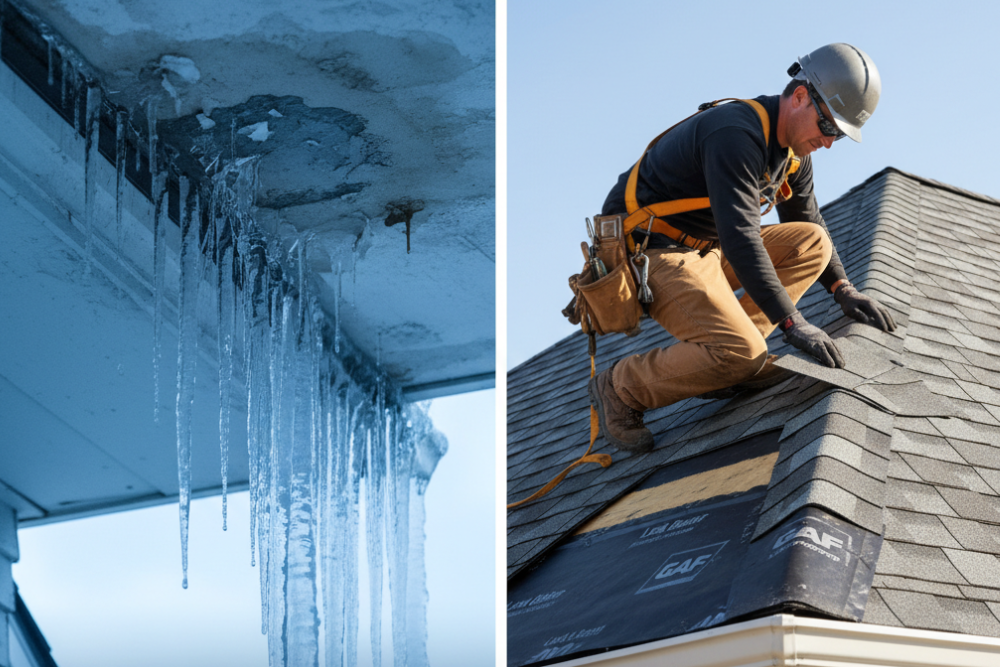
An ice dam is a ridge or barrier of ice that forms along the cold edge of a roof (the eaves) that traps melting snow behind it. This trapped water then backs up underneath the shingles and can leak directly into the walls and attic.
The process repeats in four steps:
Snow accumulates
Heat escaping from the attic melts the snow
Meltwater flows down
It hits the cold eave and refreezes, forming a dam.
Why NJ Homes Are at High Risk
New Jersey homes face unique threats that accelerate this process:
Frequent Freeze-Thaw Cycles: Our local weather constantly swings above and below freezing, which repeatedly melts and refreezes snow, accelerating the dam’s growth.
Older Construction & Insulation Deficits: Many homes, especially in Burlington, Camden, and Gloucester Counties, lack modern insulation and ventilation required today. This allows the heat escape that starts the melt.
Complex Roof Designs: Roofs with multiple slopes, valleys, and dormers create “cold traps” that harbor snow and slow down proper drainage.
2. The Compounding Costs of Damage and Neglect
The emergency cost of removing an ice dam is often only a small fraction of the total expense. The trapped water can compromise nearly every system in your home:
Interior & Structural Damage: Water soaking into your attic insulation reduces its R-value, leading to massive energy loss. Worse, water stains ceilings, promotes mold growth, and can rot roof sheathing and rafters.
Roof Surface Damage: The pressure and weight of the ice lift, crack, and permanently dislodge shingles.
Gutter & Fascia Damage: The sheer weight of a large ice dam can bend or pull your gutters away from the fascia boards entirely.
Real-Life NJ Example: In one South Jersey case, T.A. Hughes was called after a late winter thaw. The homeowner had water stains on upstairs ceilings. Our inspection revealed that an ice dam had formed, forced water under the shingles, soaked the attic insulation, and rotted roof sheathing. This repair involved replacing the structural sheathing and insulating properly—a project costing thousands.
3. The GAF Three-Part Defense System for Prevention
As GAF-certified specialists, we know that stopping ice dams requires addressing the root cause: heat loss. We use an integrated, multi-component GAF system to waterproof your roof, protect its structure, and eliminate the conditions that cause ice dams.
1. GAF Attic Ventilation: Attacking the Root Cause
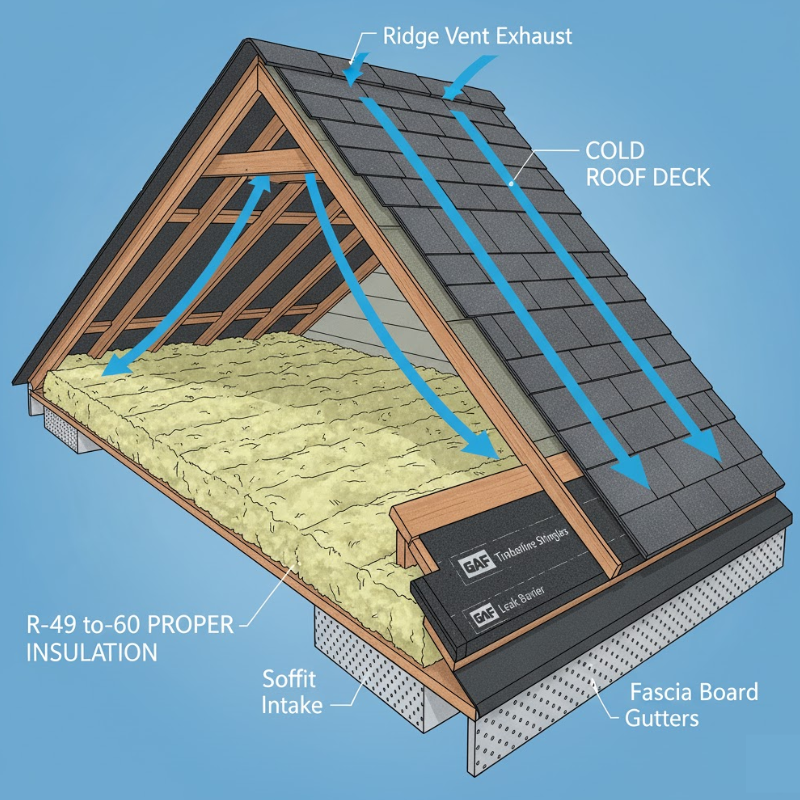
This is the primary corrective action. A balanced ventilation system uses cool air intake at the soffits and warm air exhaust at the ridge. This continuous airflow keeps the entire roof deck close to the outdoor temperature, which prevents the snow from melting in the first place. Pro-Tip: Proper insulation levels in New Jersey should target R-49 to R-60 for effective thermal control.
2. GAF Leak Barrier: Your Final Line of Defense
2. GAF Leak Barrier: Your Final Line of Defense
This specialized ice and water shield membrane (like GAF StormGuard®) is installed on the most vulnerable areas, primarily the first 3–6 feet along the eaves and in valleys. This self-sealing membrane creates an impermeable seal, preventing any water trapped by an ice dam from penetrating the roof deck.
3. GAF Deck Protection: The Secondary Shield
This underlayment covers the rest of the roof deck, providing a crucial secondary shield against water from wind-driven rain or residual moisture.
4. Cost-Benefit Comparison: Prevention vs. Emergency Repair
The numbers clearly show that a proactive, preventative strategy is the most cost-effective solution for homeowners in Burlington, Camden, and Gloucester Counties.
💰 Cost-Benefit Comparison: Reactive vs. Proactive Protection
This table highlights the clear choice between the high-cost, high-risk approach and the authoritative, cost-effective system T.A. Hughes provides.
💰 Cost-Benefit Comparison: Reactive vs. Proactive Protection
This table highlights the clear choice between the high-cost, high-risk approach and the authoritative, cost-effective system T.A. Hughes provides.
💰 Cost-Benefit Comparison: Reactive vs. Proactive Protection
This table shows why proactive protection from T.A. Hughes is smarter and more cost-effective for South Jersey homeowners.
💰 Cost-Benefit Comparison: Reactive vs. Proactive Protection
This table shows why proactive protection from T.A. Hughes III Roofing is the smarter, more cost-effective choice for South Jersey homeowners.
Metric
Reactive Approach (Emergency Removal)
Proactive Approach (Prevention)
Primary Goal
Remove the immediate ice dam symptom (treat the symptom).
Eliminate the root cause of ice dam formation (solve the problem).
Typical Cost
$400 – $4,000 per event,
plus repair costs often in the thousands (unplanned).
A one-time investment in insulation, ventilation, or a GAF Leak Barrier system that prevents recurring damage.
Long-Term Value
Low — the same issue often returns with the next freeze-thaw cycle.
High. Prevents future damage, extends roof lifespan, and improves energy efficiency.
T.A. Hughes View
A costly, recurring treatment for a temporary problem.
The smartest long-term strategy for Gloucester, Camden, and Burlington County homeowners.
5. Emergency Action: What to Do If an Ice Dam Is Already Forming
If you see signs of an active ice dam (large icicles, water stains), act quickly but safely to mitigate damage:
DO safely remove snow from the roof edge using a roof rake while standing firmly on the ground.
DO use calcium chloride in a sock or strip across the ice dam to melt a channel for drainage.
DON’T climb onto a snowy or icy roof or use sharp tools. Trying to chip or hammer the ice will almost certainly damage your shingles and gutters.
DO call professionals for safe removal. Experts use low-pressure steamers to melt the ice quickly and safely.
6. Your T.A. Hughes Master Elite® Solution for South Jersey
Choosing T.A. Hughes not only guarantees that your ice dam prevention system is installed correctly but also unlocks access to the most comprehensive warranty protection in the industry.
Master Elite® Advantage: T.A. Hughes has earned the GAF Master Elite® Contractor status, a mark of excellence earned by only approximately 2% of roofing contractors nationwide.
35+ Years of Local Experience: As a second-generation, family-owned business, we have over three decades of direct experience servicing homes in Camden, Gloucester, and Burlington Counties.
Golden Pledge® Warranty: This top-tier warranty is exclusively available through us. It provides up to 50 years (non-prorated) on materials and up to 25 years on workmanship—a level of protection unmatched by non-certified roofers. This is your best defense against future financial shocks.
Our Comprehensive Solutions Include:
Thermal Inspections to pinpoint specific areas of heat loss in your attic.
Air Sealing & Insulation Upgrades for long-term heat control.
GAF Leak Barrier and Ventilation installations for a code-compliant, integrated defense.
Financing Available: We offer flexible financing with loan amounts up to $100,000 and no home equity required to ensure your preventative investment is achievable.
Call T.A. Hughes Roofing today to schedule your comprehensive winter roof assessment at (856) 467-1645 or contact us online.
7. FAQs
Do ice dams always cause leaks? Not always—but they often lead to water intrusion if the underlayment or shingles are compromised.
How much does ice dam damage cost to repair? It depends—removing ice can cost a few hundred, but interior repairs, sheathing replacement, and insulation fixes can run into thousands.
Are gutter guards helpful against ice dams? They help with leaf/debris blockage, but they don’t solve heat loss. They’re part of the package, not the entire fix.
Will insurance cover ice dam damage? Many homeowner policies cover sudden water damage, but coverage for ice dam prevention or neglect is often excluded. Always check your policy.
8. How T.A. Hughes Roofing Solves Ice Dam Problems in South Jersey
At T.A. Hughes, we take a multi-layered approach:
Thermal inspections to detect heat loss zones
Air sealing & insulation upgrades in attics
Code‑compliant ventilation installations
Ice & water shield placement during re-roofs
Snow removal services and emergency response
Heat cable installation (if needed) in vulnerable locales
We guarantee our solutions will resist ice dam formation and protect your home from winter damage in Burlington, Camden, and Gloucester Counties.
📞 Call us today to schedule your winter roof assessment before the first freeze at (856) 467‑1645 or contact us online.